
When you ask about collective nouns for balloons, the answer is simple and fun. There is no official collective noun, but English offers several descriptive expressions. A bunch of balloons, a cluster of balloons, and a bouquet of balloons all work well. Each group of balloons sounds natural in everyday English.
Moreover, these balloon group names help English learners, students, and writers with vocabulary building. They also fit birthday parties, weddings, and festivals, where colourful balloons brighten a room. Likewise, balloons tied together make clear descriptions and simple sentences easy to write. Let us explore which collective noun usage suits each balloon display best.
What Is a Collective Noun?
A collective noun is a word that refers to a group of people, animals, or things as a unit. It allows us to describe several members together without naming each one separately.
Collective nouns make English more concise and expressive. Instead of describing every individual item, we can use one word or phrase to communicate the whole group.
Here are three simple examples:
- A flock of birds flew across the sky.
- A herd of cattle grazed in the field.
- A team of players practiced before the match.
Some collective nouns are widely used in everyday English, while others are traditional or less familiar. For objects such as balloons, speakers often use descriptive group expressions rather than specialized collective nouns. These expressions are still grammatically correct and natural.
What Is a Group of Balloons Called?
Collective Noun Finder
Discover the special collective noun for any animal, along with an interesting fact about its name.
🐾 Animal
📖 Meaning
💡 Fun Fact
A group of balloons is commonly called a bunch of balloons. Other natural expressions include a cluster of balloons, a collection of balloons, and an arrangement of balloons.
These expressions are not all specialized collective nouns. Instead, they describe how the balloons are gathered, displayed, or organized.
- A bunch of balloons: Balloons tied or gathered together, often with strings.
- A cluster of balloons: Balloons grouped closely together, often in a decorative display.
- A collection of balloons: Several balloons gathered or kept together, possibly in different colors, sizes, or designs.
- An arrangement of balloons: Balloons deliberately organized into a decorative design.
There is no single universally established, specialized collective noun for balloons. In everyday English, a bunch of balloons is a particularly natural choice.
Quick Reference Table
| Type | Simple Example |
| Bunch | A bunch of balloons |
| Cluster | A cluster of balloons |
| Collection | A collection of balloons |
| Arrangement | An arrangement of balloons |
| Group | A group of balloons |
1. A Bunch of Balloons
Meaning
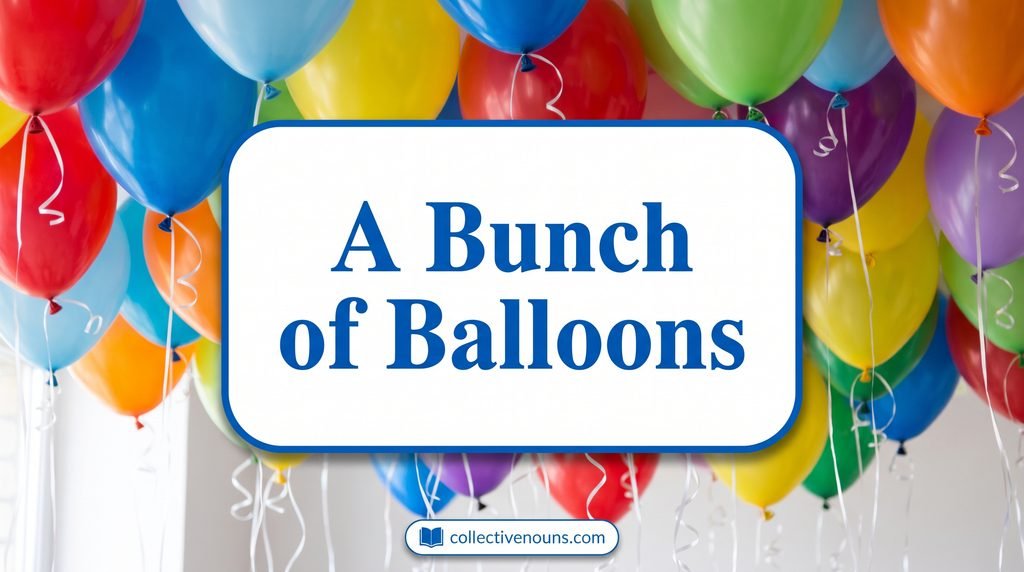
A bunch of balloons means several balloons gathered or tied together. This is a common, natural expression in everyday English. It is especially suitable for balloons held by a person, attached to a shared weight, or prepared for a celebration.
Why It Fits Balloons
The word bunch suggests that several things are collected together in one place. Balloons often appear this way at birthday parties, school celebrations, weddings, and other special events. Their strings may be tied together so that one person can carry them easily. The balloons may have matching colors or different designs, depending on the occasion. Although bunch is not an exclusive balloon-specific term, it communicates the arrangement clearly. It also works well in ordinary conversation because most English speakers understand what it means without needing a special definition.
Example Sentences
Example 1: She carried a bunch of balloons to her friend’s birthday party.
Example 2: A colorful bunch of balloons floated above the gift table.
Example 3: He bought a bunch of balloons for the school celebration.
Example 4: The children watched as a bunch of balloons swayed in the breeze.
Example 5: We tied the bunch of balloons to a chair near the entrance.
Example 6: A bunch of red and gold balloons decorated the stage.
Example 7: The shopkeeper prepared a bunch of balloons for the customer.
Example 8: My little sister smiled when she received a bunch of balloons.
Example 9: The photographer placed a bunch of balloons beside the birthday cake.
Example 10: Please keep the bunch of balloons away from the sharp table corners.
2. A Cluster of Balloons
Meaning
A cluster of balloons refers to several balloons grouped closely together. The word cluster emphasizes their arrangement and proximity. It is a natural descriptive expression used in everyday English, particularly when discussing decorations.
Why It Fits Balloons
Balloons are often arranged in clusters to create attractive displays for parties, celebrations, shops, and special events. A cluster may contain balloons of the same color or a mixture of colors and sizes. Some clusters are attached to a central point, while others form part of a larger decorative structure. The term is especially useful when describing how the balloons look rather than how they are carried. Unlike bunch, which often suggests balloons gathered by their strings, cluster emphasizes a group of balloons positioned close together.
Example Sentences
Example 1: A cluster of balloons filled the corner of the party room.
Example 2: The decorator placed a cluster of blue balloons beside the entrance.
Example 3: We noticed a bright cluster of balloons above the reception desk.
Example 4: A cluster of yellow balloons made the classroom look cheerful.
Example 5: The children gathered around the cluster of balloons near the stage.
Example 6: She used a cluster of white balloons to decorate the wedding table.
Example 7: A small cluster of balloons marked the entrance to the celebration.
Example 8: The artist arranged a cluster of balloons in different shapes and sizes.
Example 9: The cluster of balloons created a colorful background for family photographs.
Example 10: One cluster of balloons stood beside the gift table, while another decorated the doorway.
3. A Collection of Balloons
Meaning
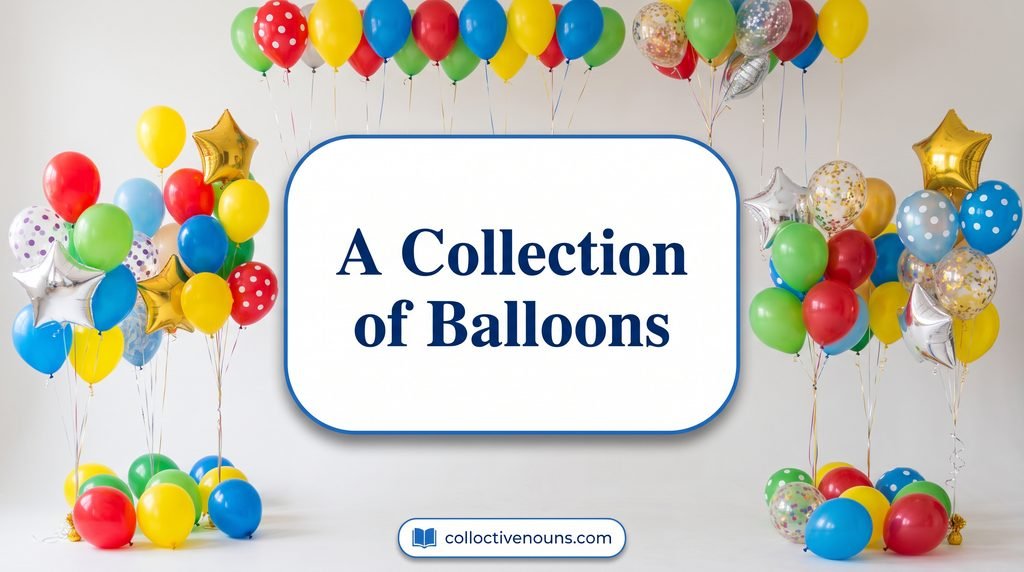
A collection of balloons means several balloons gathered, stored, or kept together. This expression can describe balloons that share a purpose or belong to the same person. It is an ordinary descriptive phrase rather than a specialized collective noun.
Why It Fits Balloons
The word collection is useful when the balloons are considered together because of their variety, ownership, or purpose. For example, a party planner may keep balloons in different colors and sizes for future celebrations. A shop may have a collection of balloons featuring different patterns, characters, and messages. Unlike bunch and cluster, the word does not require the balloons to be tied together or positioned closely. They can be stored separately and still form a collection. This makes the phrase suitable for discussing balloons as decorations, supplies, or personal possessions.
Example Sentences
Example 1: The shop displayed a collection of balloons in many colors.
Example 2: She kept a collection of patterned balloons for future celebrations.
Example 3: The party planner selected several balloons from the collection.
Example 4: Our school purchased a collection of balloons for the annual fair.
Example 5: He organized his collection of balloons by color and size.
Example 6: The store’s collection included balloons shaped like stars and hearts.
Example 7: A collection of unused balloons remained in the storage cupboard.
Example 8: The children admired the collection of balloons displayed near the counter.
Example 9: She added several metallic balloons to her growing collection.
Example 10: The collection of balloons helped the organizers prepare for different events.
4. An Arrangement of Balloons
Meaning
An arrangement of balloons refers to balloons organized into a particular design or decorative pattern. The word arrangement emphasizes the way the balloons have been positioned. It is a common descriptive phrase in event decoration and everyday English.
Why It Fits Balloons
Balloons can be arranged into arches, columns, garlands, table decorations, and other creative displays. These designs may use a combination of colors, sizes, and shapes to suit a particular celebration. The expression arrangement of balloons is appropriate when the placement of each balloon contributes to the overall appearance. Unlike bunch, which can describe a casually gathered group, arrangement usually suggests deliberate planning. The phrase is useful for describing professional decorations at weddings, birthday parties, graduation ceremonies, and business events.
Example Sentences
Example 1: An arrangement of balloons welcomed guests at the wedding reception.
Example 2: The decorator created an arrangement of pink and white balloons for the birthday party.
Example 3: We placed the balloon arrangement beside the entrance.
Example 4: A beautiful arrangement of balloons framed the stage.
Example 5: The event planner designed an arrangement of balloons in the company’s colors.
Example 6: She admired the arrangement of balloons above the dessert table.
Example 7: The children helped make a simple arrangement of balloons for their classroom.
Example 8: An arrangement of metallic balloons brightened the graduation celebration.
Example 9: The store prepared a special arrangement of balloons for the opening ceremony.
Example 10: They moved the arrangement of balloons away from the doorway to make more space.
5. A Group of Balloons
Meaning
A group of balloons is a general expression for two or more balloons considered together. It is the simplest and most flexible way to describe balloons collectively. The word group does not specify whether the balloons are tied together, arranged decoratively, or stored separately.
Why It Fits Balloons
The phrase group of balloons works in almost any situation because it does not require a particular arrangement. It can describe balloons held by children, floating near a ceiling, displayed in a shop, or used in a science demonstration. If the arrangement matters, a more descriptive phrase such as bunch, cluster, or arrangement may communicate the scene more clearly. However, there is no grammatical requirement to use a specialized group name. Ordinary group words are often the most accurate and practical choice when describing everyday objects.
Example Sentences
Example 1: A group of balloons hung above the entrance.
Example 2: The children released a group of balloons during the celebration.
Example 3: We found a group of colorful balloons behind the stage.
Example 4: A group of balloons was displayed in the shop window.
Example 5: The teacher used a group of balloons to demonstrate static electricity.
Example 6: Several students carried a group of balloons into the assembly hall.
Example 7: A group of balloons rested on the table before the party began.
Example 8: The photographer asked the children to stand beside a group of balloons.
Example 9: A group of helium-filled balloons rose toward the ceiling.
Example 10: The organizers moved the group of balloons into the decorated room.
How to Use Collective Nouns for Balloons

Using collective expressions for balloons is simple once you understand how the words fit into a sentence.
1. Place the group word before “of.”
Words such as bunch, cluster, collection, and arrangement can be followed by of and the plural noun balloons.
- A bunch of balloons decorated the room.
- A cluster of balloons stood near the entrance.
- A collection of balloons was available in the shop.
2. Use “a” or “an” correctly.
Use a before a consonant sound and an before a vowel sound.
- A bunch of balloons
- A cluster of balloons
- A collection of balloons
- An arrangement of balloons
The choice depends on the sound at the beginning of the next word, not on the word balloons.
3. Choose a word that matches the situation.
Use bunch when balloons are gathered together, cluster when they are close together, and arrangement when they have been organized into a design. Use group when you simply mean several balloons.
4. Remember subject–verb agreement.
When the group is treated as one unit, a singular verb is natural.
- A bunch of balloons is hanging by the door.
- A collection of balloons was stored in the cupboard.
The group word, rather than the plural noun balloons, determines the verb in these examples.
Should You Use a Singular or Plural Verb?
The correct verb depends on the subject of the sentence and whether you are treating the group as one unit or emphasizing its individual members.
In standard English, the group words bunch, cluster, collection, and arrangement are generally singular when they refer to one group.
For example:
- A bunch of balloons is tied to the chair.
- The cluster of balloons looks beautiful.
- A collection of balloons was stored safely.
- The arrangement of balloons is ready for the event.
The word balloons is plural, but it is part of the phrase beginning with of. The main subject is the singular group word.
Compare these examples:
- The bunch is near the window. — The bunch is treated as one unit.
- The balloons are near the window. — The individual balloons are the subject.
In British English, plural agreement is sometimes used with collective nouns when the members are being emphasized. However, this is less natural with many object-group expressions than with collective nouns referring to people or animals.
For clear, standard English, use a singular verb with a bunch, a cluster, a collection, or an arrangement when referring to one group.
Interesting Facts About Balloons
Balloons may seem like simple party decorations, but they demonstrate several interesting principles of physics and material science. Their appearance, movement, durability, and interaction with the environment depend on the materials used and the gas inside them.
Longevity
A balloon’s lifespan depends on its material, inflation method, storage conditions, and exposure to sunlight, heat, and air. An inflated balloon may remain usable for hours or days, but the exact duration varies considerably.
Latex balloons generally lose their inflation more quickly than many foil balloons because gases can gradually pass through the latex material. Foil balloons often retain their shape and gas longer, although they can still leak or become damaged. Uninflated balloons may last much longer when stored properly, but heat, sunlight, and aging can weaken their materials.
Outdoor conditions can shorten a balloon’s useful life. Wind, sharp surfaces, and temperature changes can affect its shape and durability. There is no single lifespan that applies to every balloon.
Unique Physical Features
Balloons are flexible containers that expand when filled with gas. Many ordinary party balloons are made from latex, a stretchy material that can expand as internal pressure increases. Foil balloons use thin sheets of plastic and metalized material, giving them a different texture and appearance.
A balloon’s ability to float depends on the relationship between its total weight and the surrounding air. A balloon filled with helium can rise because helium is less dense than air. A balloon filled with ordinary air generally does not float upward in the same way because the air inside it has a density similar to the surrounding air, while the balloon material adds weight.
The shape of a balloon also affects how it moves through the air. A balloon can wobble, rotate, or drift when currents of air push against its surface. Its movement is influenced by its shape, weight, string, and surrounding conditions.
Dietary Habits
Balloons do not eat food because they are inanimate objects, not living organisms. They have no digestive system, metabolism, or biological need for nutrients.
However, the materials used to manufacture balloons come from different sources. Many latex balloons are made from natural rubber latex, which comes from the rubber tree. Foil balloons are made from manufactured materials rather than plant tissue. These differences concern material production, not diet.
Although balloons themselves do not require food, they can pose risks to wildlife when discarded outdoors. Animals may swallow balloon fragments or become entangled in ribbons and strings. Proper disposal helps reduce these hazards.
Social Behavior
Balloons do not have social behavior because they are not living creatures. They do not form families, communicate intentionally, cooperate, or establish territories.
Nevertheless, balloons often appear in groups because people use them together for decoration, celebrations, demonstrations, and advertising. Their movement can also make them appear to behave collectively. For example, several helium-filled balloons tied together may rise and sway as a unit, while a cluster of balloons near a fan may move in similar directions.
These movements are explained by physical forces, including buoyancy, gravity, air resistance, and air currents. Describing a bunch of balloons is therefore a language choice, not evidence that balloons possess animal-like social structures.
Why Are Animal Collective Nouns So Interesting?

English has many distinctive expressions for groups of animals. Examples include a flock of birds, a herd of cattle, and a school of fish. These terms make language more vivid and allow speakers to describe groups concisely.
Some animal group names reflect observable features, such as movement or living arrangements. Others survive through traditional vocabulary, literature, and cultural usage. Their meanings and popularity can vary depending on the animal, context, and English-speaking community.
It is important not to assume that every collective noun has a clear scientific origin or accurately describes the behavior of every animal in a group. Some expressions are conventional language rather than biological classifications.
Balloons provide a useful comparison. English speakers naturally say a bunch of balloons or a cluster of balloons, but these expressions do not indicate that balloons have a biological group structure. They simply describe how objects are gathered or arranged.
Learning collective nouns can therefore improve vocabulary while teaching an important lesson: language describes the world in useful ways, but a word’s meaning is not always a scientific explanation.
Collective Nouns vs. Ordinary Group Words
Collective nouns and ordinary group words help us talk about several things together, but their usage differs depending on the word and context.
Here are some common group expressions:
- A herd: Usually refers to certain grazing or large land animals, such as cattle or deer.
- A pack: Commonly describes certain animals, such as wolves or dogs, traveling or living together.
- A flock: Often refers to birds or sheep.
- A school: Commonly describes a group of fish swimming together.
- A colony: Can refer to animals of the same species living together in a particular area.
- A bunch: Describes things gathered together, such as balloons, flowers, or grapes.
- A cluster: Describes things positioned close together, such as balloons or stars.
- A group: A general word for several people, animals, or objects.
The words herd, pack, flock, school, and colony are associated with particular kinds of animal groups, although usage can vary. By contrast, bunch, cluster, and group are flexible expressions that can describe many kinds of objects.
For balloons, a bunch of balloons is a natural everyday expression. A cluster of balloons is particularly suitable when describing a close arrangement, while a group of balloons works in almost any context.
The phrase a group of balloons remains grammatically correct even when a more descriptive expression is available. English speakers do not need to memorize a special word for every collection of objects.
See Also: Phrasal Verbs for Look Into
What Collective Nouns Tell Us About Balloons
The expressions used for balloons show how English organizes objects into meaningful groups. Words such as bunch, cluster, and arrangement emphasize different qualities: how the balloons are gathered, how close they are, or how carefully they have been positioned.
These distinctions make descriptions more precise. For instance, a bunch of balloons may suggest balloons tied together for carrying, while an arrangement of balloons suggests a planned decorative design. Both expressions can refer to the same balloons, but each highlights a different aspect of the scene.
Unlike animal collective nouns, these phrases do not describe a biological social structure. Balloons do not make decisions, cooperate, or develop relationships. Their movements are caused by physical forces, and their grouping usually results from human activity.
This distinction between traditional language and modern scientific knowledge is useful for English learners. Collective expressions can help us describe what we observe, but the expressions themselves do not prove why something behaves in a particular way.
Frequently Asked Questions
What is the collective noun for balloons?
There is no official collective noun for balloons. However, bunch of balloons, cluster of balloons, and bouquet of balloons are common descriptive expressions in everyday English.
Which collective noun fits balloons tied together best?
Balloons tied together often look like a cluster of balloons or a bunch of balloons. Both phrases give clear descriptions of a tight group of balloons.
What do you call balloons arranged like flowers?
A bouquet of balloons fits balloons arranged like flowers best. Therefore, it works well for a balloon display or decorative arrangement.
Where do people use a bunch of balloons?
People use them at birthday parties, weddings, festivals, and school functions. Also, balloon decorations make special events feel colourful and fun.
Conclusion
In short, collective nouns for balloons are flexible and easy to use. Although there is no official collective noun, a bunch of balloons, a cluster of balloons, or a bouquet of balloons fits most birthday parties, weddings, and special events. As a result, English learners, students, and writers can pick balloon group names that make simple sentences and clear descriptions sound natural in everyday English.
Share Your Review
Were these responses helpful? Rate below:

Naeem Raza is a passionate language enthusiast and experienced writer with multiple years of experience exploring collective nouns and phrasal verbs. He enjoys making English grammar and vocabulary easier to understand through clear explanations, practical examples, and engaging educational content. At colloctivenouns.com, Naeem shares helpful language resources designed to build readers’ confidence and communication skills. Explore more of his content to make learning English enjoyable and rewarding.