Many people ask, what is a group of pheasants called, and the answer has a few fun options. The most common collective nouns for pheasants are a nye of pheasants, a nide of pheasants, and a bouquet of pheasants. You may also see a brood of pheasants, a covey of pheasants, a bevy of pheasants, or a brace of pheasants. These traditional collective nouns show how rich animal group names can be in English.
Each term fits a different setting. A brood of chicks describes a family group of pheasants, while a brace of pheasants means a pair of pheasants or two pheasants. Meanwhile, bouquet raises a subject-verb agreement question, so many writers ask if bouquet is or bouquet are correct. Whether you are one of the English learners, students, teachers, or animal lovers, this guide explains each collective noun meaning in plain words.
What Is a Collective Noun?
A collective noun is a word that describes a group of people, animals, or things as a unit. It helps us communicate clearly without naming every member of a group individually.
For example:
- A flock of birds flew across the field.
- A herd of cattle grazed near the fence.
- A team of players practiced after school.
In each sentence, the collective noun identifies several individuals as a group. These words are useful in conversations, stories, school assignments, and wildlife writing.
Some collective nouns are common in everyday English, such as flock and herd. Others are traditional or literary expressions that readers may encounter in older books or specialized animal vocabulary. Understanding the difference helps English learners choose words that sound natural and avoid treating every traditional term as a scientific description.
What Is a Group of Pheasants Called?
Collective Noun Finder
Discover the special collective noun for any animal, along with an interesting fact about its name.
🐾 Animal
📖 Meaning
💡 Fun Fact
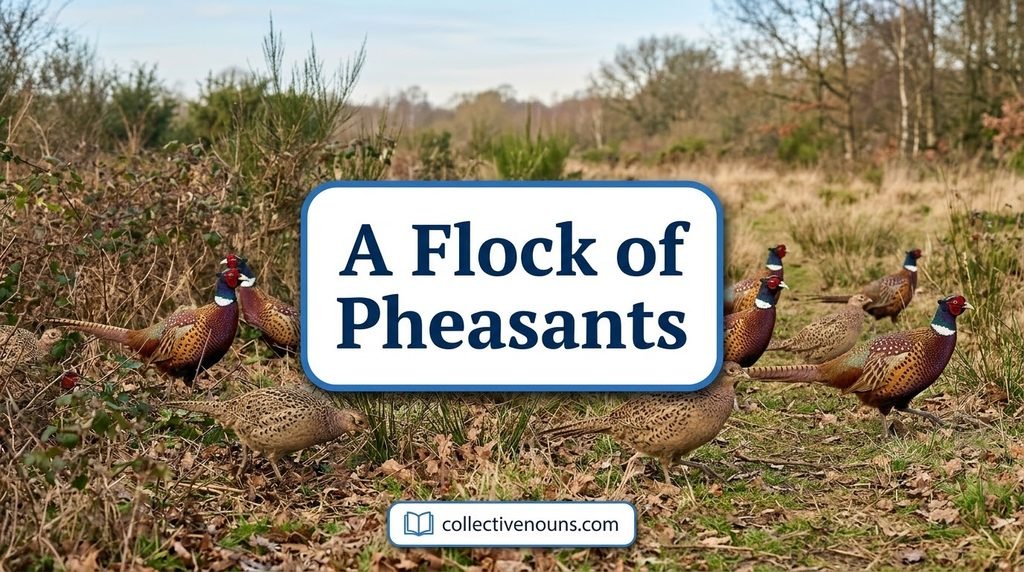
A group of pheasants is commonly described as a flock of pheasants. The word flock is a familiar, practical choice when referring to several birds together.
Another traditional collective noun associated with pheasants is a bouquet of pheasants. This is an unusual, old-fashioned expression rather than the ordinary term most people would use in everyday conversation.
The best choice depends on your purpose. Use flock for clear, natural English. You may use bouquet when discussing traditional animal group names or writing in a deliberately literary style. Neither expression means that pheasants always live together in large, permanent groups.
Quick Reference Table

| Type | Simple Example |
| Flock | A flock of pheasants |
| Bouquet | A bouquet of pheasants |
1. A Flock of Pheasants
Meaning
A flock is a group of birds gathered or moving together. It is the most straightforward collective noun to use when describing pheasants in everyday English. The word is familiar to readers and does not require specialist knowledge of traditional animal vocabulary.
Why It Fits Pheasants
Common pheasants may form loose flocks outside the breeding season, particularly during autumn and winter when birds gather in areas offering food and protective cover. These groups may contain males, females, or birds of both sexes. Pheasants spend much of their time on the ground, searching for food among grasses, crops, and low vegetation. When startled, they may scatter or take flight. The word flock describes this group behavior naturally without suggesting that pheasants remain together throughout the year.
Examples
Example 1: A flock of pheasants crossed the grassy field at dawn.
Example 2: We watched a flock of pheasants feeding near the hedgerow.
Example 3: The farmer spotted a flock of pheasants beside the wheat crop.
Example 4: A flock of pheasants disappeared into the tall grass.
Example 5: Several children observed a flock of pheasants from a quiet distance.
Example 6: The flock of pheasants moved toward an area with thicker vegetation.
Example 7: At sunset, a flock of pheasants searched the ground for fallen seeds.
Example 8: A wildlife photographer waited patiently for the flock of pheasants to emerge.
Example 9: The flock of pheasants scattered when a sudden noise startled the birds.
Example 10: During winter, we sometimes see a flock of pheasants near the woodland edge.
2. A Bouquet of Pheasants
Meaning
A bouquet of pheasants is a traditional collective expression associated with these birds. Although bouquet ordinarily means a bunch of flowers, it also appears in traditional lists of animal group names. It is an unusual expression in modern everyday English and is best understood as a traditional or literary term, not the standard word for every group of pheasants.
Why It Fits Pheasants
The word bouquet is particularly associated in traditional descriptions with pheasants rising or being flushed into flight. The sight of several colorful birds taking off together can make this expression memorable. Male pheasants often have striking plumage, including iridescent colors and long tails, while females usually have more subdued, patterned feathers. Nevertheless, the term does not describe a biological category or a fixed type of flock. For ordinary wildlife observation, flock of pheasants remains the clearer choice.
Examples
Example 1: The naturalist used the traditional expression a bouquet of pheasants in her notes.
Example 2: The old countryside guide described a bouquet of pheasants rising above the grass.
Example 3: Several pheasants took flight together, reminding the writer of a traditional bouquet of pheasants.
Example 4: The student discovered the expression bouquet of pheasants while studying animal vocabulary.
Example 5: The teacher explained that a bouquet of pheasants is an unusual collective noun.
Example 6: In his wildlife journal, the author recorded the traditional term for a bouquet of pheasants.
Example 7: The guide discussed a bouquet of pheasants while introducing historical bird terminology.
Example 8: A sudden disturbance sent several pheasants into the air, creating a dramatic scene for the observer.
Example 9: The class compared the traditional phrase bouquet of pheasants with the familiar phrase flock of birds.
Example 10: Although bouquet of pheasants sounds poetic, the photographer chose the simpler phrase flock of pheasants for her caption.
3. A Nye of Pheasants
Meaning
A nye of pheasants is a traditional, specialized expression for a group of pheasants. It is uncommon in everyday conversation, and many English speakers may not recognize it. The word is mainly useful when exploring traditional animal group names, historical vocabulary, or literary descriptions.
Why It Fits Pheasants
The term nye is associated specifically with pheasants in traditional collective-noun lists. However, it should not be treated as a scientific term or as proof that pheasants have a unique social structure. Pheasant species differ in their behavior, and the size and composition of a group depend on factors such as breeding season, food availability, and habitat. If you are describing birds observed in a field or wildlife reserve, flock is usually easier for readers to understand. The expression nye is more suitable when the traditional vocabulary itself is the subject.
Examples
Example 1: The vocabulary lesson introduced the traditional expression a nye of pheasants.
Example 2: The student wrote the phrase nye of pheasants in a notebook about animal group names.
Example 3: The teacher explained why a nye of pheasants is less familiar than a flock of birds.
Example 4: The wildlife club discussed the word nye during its English vocabulary session.
Example 5: The old glossary included a nye of pheasants among its traditional expressions.
Example 6: The reader paused to look up the meaning of nye in a reference book.
Example 7: A discussion of traditional bird vocabulary included the expression nye of pheasants.
Example 8: The writer used the phrase nye of pheasants while explaining unusual collective nouns.
Example 9: The class compared a nye of pheasants with a flock of geese.
Example 10: For a general audience, the author explained the rare word nye before using it in a sentence.
4. A Nide of Pheasants
Meaning
A nide of pheasants is another traditional term found in some collections of animal group names. Like nye, it is uncommon in ordinary conversation. Its precise usage is not consistent enough to make it the preferred everyday expression for a group of pheasants.
Why It Fits Pheasants
The word nide appears in traditional vocabulary associated with pheasants, sometimes in descriptions of birds gathered on the ground. Some references discuss nide alongside nye, although accounts of their meanings and origins are not entirely consistent. Modern wildlife descriptions focus instead on observable details, such as the number of birds, their location, and whether they are feeding, resting, or breeding. For this reason, nide is best introduced as an uncommon traditional expression. A simple phrase such as a group of pheasants will communicate the meaning clearly when precision matters more than literary style.
Examples
Example 1: The class learned that a nide of pheasants is an uncommon traditional expression.
Example 2: The student added nide of pheasants to a list of unusual animal group names.
Example 3: The reference book discussed the word nide in its section on bird vocabulary.
Example 4: The teacher compared a nide of pheasants with the more familiar phrase a flock of pheasants.
Example 5: A reader searched for the meaning of nide after finding it in an old glossary.
Example 6: The writer explained the traditional expression nide of pheasants before introducing more familiar vocabulary.
Example 7: During the lesson, the class examined how a nide of pheasants differs in familiarity from a flock of birds.
Example 8: The wildlife journal used the ordinary phrase group of pheasants to avoid confusing its readers.
Example 9: The student recognized nide as a traditional term rather than a scientific classification.
Example 10: The article mentioned a nide of pheasants while discussing the history of English animal vocabulary.
5. A Brood of Pheasants
Meaning
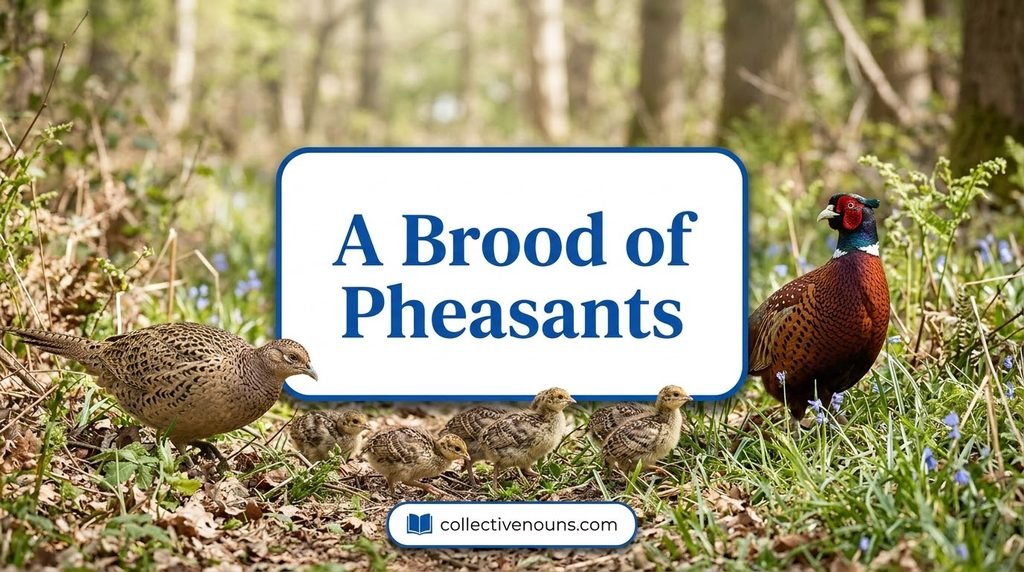
A brood is a group of young birds hatched or cared for around the same period. The word is a familiar term in bird and wildlife descriptions, especially when discussing chicks and their relationship with a parent. In the case of pheasants, brood is more specific than flock because it refers to a family-related group of young birds rather than simply several pheasants gathered together.
Why It Fits Pheasants
Female pheasants generally build nests on the ground, concealed among grass or other vegetation. After hatching, the chicks leave the nest and follow the hen while feeding for themselves. Young pheasants consume many insects during their early development, which provide valuable protein. A brood therefore provides a useful way to describe a hen and her young in a nesting or wildlife-observation context, although the exact meaning can depend on whether the writer is referring to the chicks alone or the family group. It should not be used as a general substitute for every group of adult pheasants.
Examples
Example 1: A brood of pheasants followed the hen through the tall grass.
Example 2: The wildlife observer spotted a brood of pheasant chicks beside a field.
Example 3: The mother pheasant led her brood toward a patch of dense vegetation.
Example 4: A brood of pheasants searched for insects among the low plants.
Example 5: The farmer noticed a brood of pheasant chicks near the field boundary.
Example 6: The hen kept a watchful eye on her brood as they explored their surroundings.
Example 7: A brood of pheasants disappeared beneath the protective cover of the hedgerow.
Example 8: The naturalist recorded the location of a brood of pheasants without disturbing the birds.
Example 9: The young birds in the brood moved through the grass while their mother foraged nearby.
Example 10: The conservation team protected the nesting habitat used by the hen and her brood.
Read More: Collective Nouns for Events
How to Use Collective Nouns for Pheasants
Using collective nouns for pheasants is straightforward once you understand how the words fit into a sentence.
1. Place the collective noun before “of.”
The word of connects the group name with the animals.
- A flock of pheasants crossed the field.
- A brood of pheasant chicks followed their mother.
2. Use “a” or “an” correctly.
Use a before a collective noun that begins with a consonant sound. For example, a flock, a bouquet, a nye, and a nide.
3. Match the verb to the meaning.
When the group is treated as one unit, a singular verb is natural.
- The flock is moving toward the trees.
- The brood is resting in the grass.
4. Choose a term that suits your meaning.
Use flock for a general group of pheasants, brood for young birds or a family-related group, and traditional terms such as bouquet when the context supports their use.
Remember that “a group of pheasants” is always a useful alternative when you are unsure which specialized term to choose.
See Also: Collective Nouns for Events
Should You Use a Singular or Plural Verb?
A collective noun can take a singular or plural verb, depending on the variety of English and whether the writer views the group as one unit or as individual birds.
In American English, collective nouns are generally treated as singular when the group acts together. British English more readily allows plural agreement when attention is on the individual members.
Examples:
- The flock is moving across the field. The flock is treated as one unit.
- The flock are spreading out across the field. The individual birds are emphasized; this usage is more natural in British English.
- The brood is following its mother. The young birds are viewed as one family group.
- The pheasants are feeding near the hedgerow. The plural noun pheasants takes a plural verb.
For English learners, the safest general approach is to use a singular verb when the collective noun represents the group as a whole. Follow the conventions of your chosen English variety when emphasizing individual members.
Interesting Facts About Pheasants
Longevity
The lifespan of a pheasant depends on its species, environment, and exposure to predators and other dangers. Common pheasants often have short lives in the wild because young birds face substantial mortality, and adults may be killed by predators, harsh weather, agricultural activities, and hunting. Some wildlife references give an average lifespan of around one to three years for wild common pheasants, although survival varies considerably between populations. Birds kept in captivity under suitable conditions can live considerably longer. Therefore, there is no single lifespan that applies to every pheasant.
Unique Physiological Features
Pheasants belong to the pheasant family, Phasianidae, which also includes partridges, grouse, and related birds. Many species have strong legs adapted for walking and running on the ground. Their wings allow them to make powerful, often sudden flights when disturbed, although they spend much of their time on the ground.
The common pheasant is especially recognizable because of its long tail and colorful plumage. Males typically have brighter feathers, a red facial area, and a greenish head or neck, while females tend to have brown, patterned feathers that help them blend into their surroundings. These differences are examples of sexual dimorphism, meaning that males and females of the same species have different physical characteristics.
Pheasants also use their bills and feet to scratch through soil and leaf litter in search of food. Their coloration, alert behavior, and ability to move quickly through vegetation help them navigate habitats where cover is important.
Dietary Habits
Pheasants are generally omnivores, meaning that they eat both plant and animal matter. Their diet commonly includes seeds, grains, berries, leaves, shoots, and insects. Depending on the species and local food supply, they may also eat other small invertebrates.
Common pheasants often forage on the ground, scratching at soil and vegetation to uncover food. Agricultural landscapes can provide fallen grain, while grasslands and woodland edges offer seeds, insects, and plant material. The balance of foods changes with the season and availability.
Young pheasant chicks rely heavily on insects during their early development. This food provides protein and other nutrients needed for growth. Their diet gradually becomes more similar to that of adults as they mature.
Social Behavior
Pheasant social behavior varies by species and season. Common pheasants may form loose flocks during autumn and winter, particularly where food and shelter are available. During the breeding season, males may establish territories and display to attract females.
In many common pheasant populations, one male may mate with several females. The female generally chooses a concealed nesting site on the ground, incubates the eggs, and cares for the young after hatching.
Pheasants communicate through calls, displays, and body movements. A male common pheasant can produce a loud, harsh call, especially during territorial or breeding activity. When threatened, pheasants may run toward cover or burst into flight.
These behaviors explain why terms such as flock and brood are useful in wildlife descriptions. However, not all pheasant species behave in exactly the same way, and a collective noun should never be treated as a complete scientific description of their social lives.
Why Are Animal Collective Nouns So Interesting?

Animal collective nouns show how English can describe the natural world with a single word. Instead of saying that many birds are gathered together, we can use flock. Instead of describing a female bird and her young at length, we can refer to a brood.
Some animal group names have become ordinary vocabulary, while others survive mainly in traditional lists, old books, and literary descriptions. Expressions such as bouquet, nye, and nide are interesting examples of specialized vocabulary associated with pheasants.
The history of such words is not always clear. Some traditional terms may have developed through hunting vocabulary, regional speech, or literary conventions, but an exact origin should not be assumed without reliable evidence.
Learning these expressions helps students explore the relationship between language, culture, and wildlife. It also teaches an important lesson: an unusual word may be historically interesting without being necessary in everyday communication.
Collective Nouns vs. Ordinary Group Words
Collective nouns and ordinary group words both help us describe several animals together, but they do not always carry the same meaning.
| Word | General Meaning | Example |
| Flock | A group of birds | A flock of pheasants crossed the field. |
| Herd | A group of certain animals, especially grazing mammals | A herd of deer grazed nearby. |
| Pack | A group of animals commonly associated with coordinated social activity | A pack of wolves moved through the forest. |
| School | A group of fish or certain other aquatic animals | A school of fish swam past. |
| Colony | A group of animals living together in a particular area | A colony of penguins gathered along the shore. |
| Group | A general word for several individuals | A group of pheasants fed near the hedgerow. |
| Brood | A group of young birds, especially those hatched or cared for together | A brood of pheasant chicks followed the hen. |
The word group is a general term that works in almost any situation. More specific words provide additional information about the type of animals or their relationship.
For example, “a group of pheasants” is grammatically correct and easy to understand. “A flock of pheasants” is more specific because it uses a familiar bird-related collective noun.
Traditional expressions such as bouquet, nye, and nide add variety to animal vocabulary, but they are not essential for clear communication. Choose the word that best suits your audience and purpose.
What Collective Nouns Tell Us About Pheasants
Collective nouns offer clues about how people have traditionally observed and described animals. The word flock reflects a familiar way of speaking about birds gathered together, while brood focuses attention on young birds and their family relationship.
Traditional expressions such as bouquet of pheasants also show how imaginative English vocabulary can be. They may create vivid pictures in the reader’s mind, especially in descriptive or literary writing.
However, traditional language and modern biological knowledge are not the same thing. A collective noun does not establish how pheasants must behave. Some pheasants form loose flocks, while others may spend considerable time alone or in smaller groups, depending on their species and circumstances.
A wildlife researcher would describe the actual number of birds, their behavior, and their habitat rather than relying on an unusual collective noun alone.
For students, the distinction is valuable. Learning animal group names improves vocabulary, while observing animals and studying reliable wildlife information builds a more accurate understanding of nature.
FAQs
What is a group of pheasants called?
A group of pheasants has several names. Common pheasant group names include a nye of pheasants, a nide of pheasants, and a bouquet of pheasants.
What is the collective noun for pheasants in a family?
A brood of pheasants often describes a family group of pheasants. Likewise, a brood of chicks means a group of young pheasants.
What does a brace of pheasants mean?
A brace of pheasants means a pair of pheasants. In other words, it refers to two pheasants.
Is a bouquet of pheasants singular or plural?
Writers often ask bouquet is or bouquet are, and both can work. Use a singular or plural verb based on whether you mean one group or many birds.
Share Your Review
Were these responses helpful? Rate below:

Ahmad Raza is a passionate language enthusiast and experienced writer with multiple years of experience exploring collective nouns and phrasal verbs. Through his work at colloctivenouns.com, he makes English grammar and vocabulary easier to understand with practical explanations, helpful examples, and engaging learning resources. He enjoys helping readers communicate more confidently and naturally. Explore his latest articles on colloctivenouns.com and continue your journey toward better English.