
Many people ask, what is a group of swans called, and the answer depends on where the birds are. The most common collective nouns for swans include a bevy of swans on water and a wedge of swans in the sky. Other animal group names like a flock of swans or a flotilla of swans also appear in everyday speech. These graceful waterbirds show elegant movements on lakes, ponds, and rivers.
Each term adds descriptive language and gives English learners a clearer picture. For example, swans in V formation look like a wedge, so the name fits well. Teachers and students can use these collective noun examples to improve word choice in descriptive writing. This guide explains each bevy meaning, wedge meaning, and more with simple grammar examples.
What Is a Collective Noun?
A collective noun is a word that names a group of people, animals, or things. It allows us to describe several individuals as a single group.
Collective nouns are useful because they make communication more natural and concise. They also add variety to English vocabulary.
Here are three simple examples:
- A team of players prepared for the match.
- A herd of cattle grazed in the field.
- A flock of birds flew across the sky.
Some collective nouns are used frequently in everyday English, while others are traditional, specialized, or mainly literary. Understanding this difference helps you choose the right expression for ordinary conversation, schoolwork, and creative writing.
What Is a Group of Swans Called?
Collective Noun Finder
Discover the special collective noun for any animal, along with an interesting fact about its name.
🐾 Animal
📖 Meaning
💡 Fun Fact
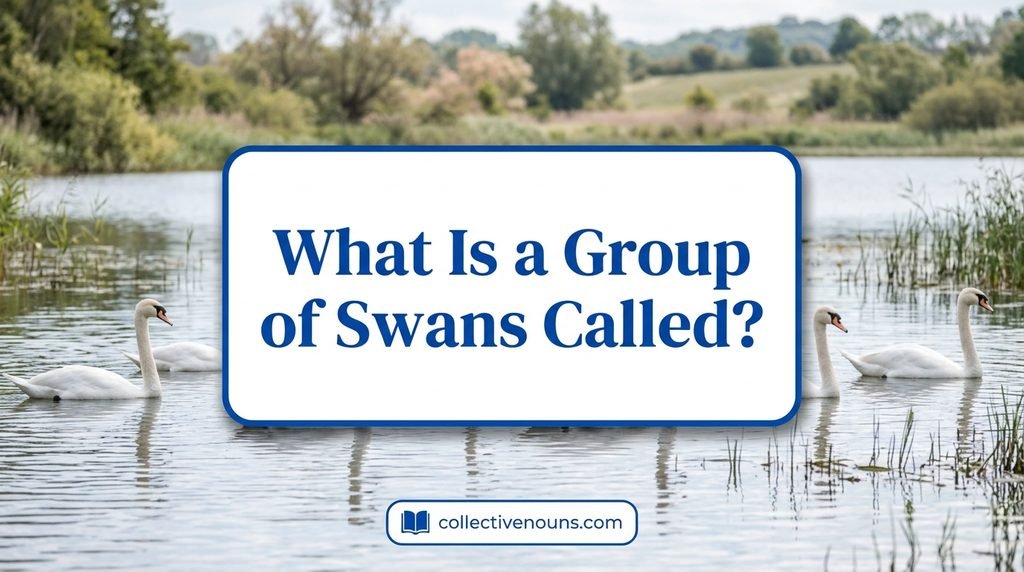
A group of swans is commonly called a flock of swans. Other expressions associated with swans include a bevy of swans, a wedge of swans, and a team of swans.
The most useful term for everyday English is flock. It is widely understood and describes a group of birds without suggesting that they must be behaving in a particular way.
A bevy is a traditional collective noun for swans, although it is less common in everyday conversation. A wedge describes a group flying in a wedge-shaped formation, while team is a traditional term that readers may encounter in lists of animal collective nouns. These expressions are not equally common, and some are more appropriate for descriptive or literary writing than ordinary speech.
Quick Reference Table
| Type | Simple Example |
| Flock | A flock of swans |
| Bevy | A bevy of swans |
| Wedge | A wedge of swans |
| Team | A team of swans |
| Group | A group of swans |
1. A Flock of Swans
Meaning
A flock of swans is a group of swans gathered together. Flock is the most practical and widely understood collective noun for swans in modern English. It is also used for many other birds, including geese, ducks, and sparrows.
Why It Fits Swans
Swans may gather on lakes, rivers, ponds, and wetlands to feed, rest, or move between suitable habitats. Some groups include young birds, while others consist of adults that come together outside the breeding season. Swans do not necessarily remain in large flocks all year. Many establish breeding territories and spend considerable time with their mates and offspring. Nevertheless, when several swans gather in one place, flock provides a clear and natural description. It works whether the birds are swimming across a lake, feeding near the shore, or flying overhead.
Examples
Example 1: A flock of swans glided across the quiet lake.
Example 2: We watched a flock of swans feeding near the riverbank.
Example 3: The photographer waited patiently for the flock to move into the sunlight.
Example 4: A flock of swans rested on the water during the afternoon.
Example 5: Several children observed the flock from the lakeside path.
Example 6: A flock of swans flew over the wetland at dawn.
Example 7: The nature guide pointed out a flock of swans near the reeds.
Example 8: The flock scattered briefly when a boat approached.
Example 9: Visitors admired the flock as it crossed the pond.
Example 10: By evening, the flock had gathered near a sheltered part of the lake.
2. A Bevy of Swans
Meaning
A bevy of swans is a traditional collective expression for a group of swans. The word bevy is also used for groups of other things, including people, depending on the context. Although it is recognized in traditional animal vocabulary, it is less common than flock in everyday speech.
Why It Fits Swans
The expression bevy of swans gives a description a traditional or literary flavor. It can be useful in nature writing, descriptive passages, and stories where the writer wants to emphasize the beauty of several swans gathered together. A group of swans on a calm lake may create an elegant scene, making this expression suitable for evocative prose. However, the word does not indicate a particular biological behavior, family structure, or scientific category. It is a vocabulary choice rather than a precise description of how swans organize themselves.
Examples
Example 1: A bevy of swans floated gracefully across the lake.
Example 2: The poet described a bevy of swans beneath the morning sky.
Example 3: A bevy of swans gathered in the sheltered bay.
Example 4: We spotted a bevy of swans beside the grassy shore.
Example 5: The painting showed a bevy of swans surrounded by water lilies.
Example 6: A bevy of swans rested on the pond while the wind softened.
Example 7: The visitor admired the bevy from a quiet viewing platform.
Example 8: In her story, a bevy of swans appeared beside an ancient castle.
Example 9: The guide described the bevy as it moved toward the reeds.
Example 10: At sunset, a bevy of swans added beauty to the peaceful wetland.
3. A Wedge of Swans
Meaning
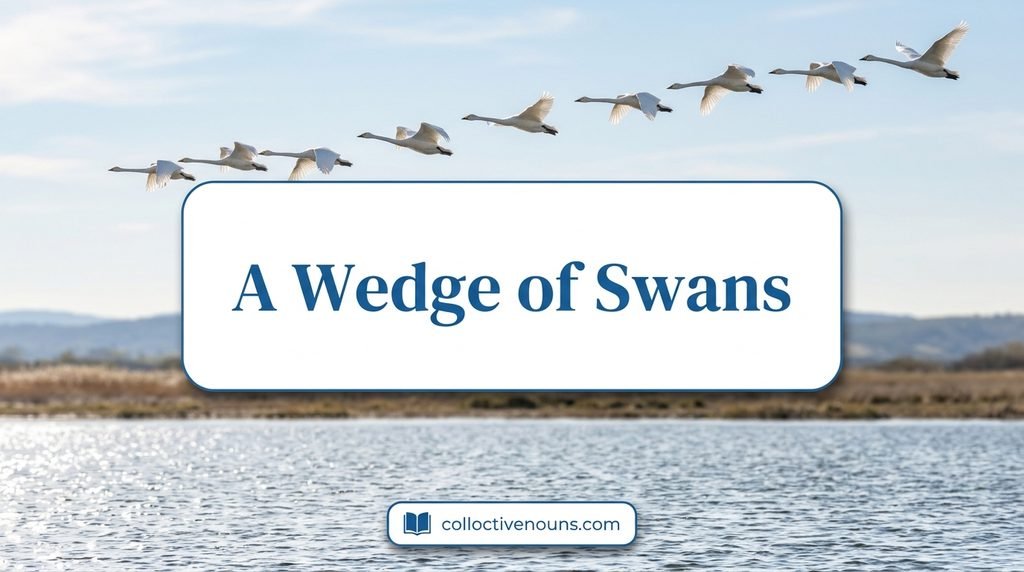
A wedge of swans describes a group of swans flying in a wedge-shaped formation. Unlike flock, which identifies a group of birds generally, wedge draws attention to the group’s arrangement in the sky.
Why It Fits Swans
Swans are powerful fliers, and some species travel between breeding and wintering areas. During flight, groups of swans may form angled lines or other arrangements that change as the birds move. A wedge-shaped formation can be described as a wedge, although not every group of flying swans will form this shape. The term is most useful when the birds’ formation is clearly visible. It describes their appearance during flight rather than a permanent social group. In ordinary writing, a flock of swans remains suitable even when the exact formation is unknown.
Examples
Example 1: A wedge of swans crossed the pale morning sky.
Example 2: We watched a wedge of swans flying above the marsh.
Example 3: The birdwatcher photographed the wedge as it passed overhead.
Example 4: A wedge of swans appeared above the distant fields.
Example 5: The children pointed toward a wedge of swans moving south.
Example 6: A wedge of swans passed over the lake before disappearing behind the hills.
Example 7: The formation changed as the swans continued their flight.
Example 8: From the riverbank, we could see a wedge of swans against the clouds.
Example 9: The wildlife photographer waited for a wedge of swans to enter the frame.
Example 10: A wedge of swans flew beyond the wetland as daylight faded.
4. A Team of Swans
Meaning
A team of swans is a traditional collective expression sometimes found in animal collective-noun lists. It is not the usual choice in everyday descriptions of wild swans. In most situations, flock is clearer and more natural.
Why It Fits Swans
The word team usually suggests individuals working together toward a shared goal. When applied to swans, it may appear in traditional vocabulary lists or creative writing, but it should not be interpreted as proof that swans function as a coordinated team in the human sense. Swans can show social interactions, maintain pair bonds, and care for their young. These behaviors are better explained through their biology than through the word team. If you are writing a school assignment or a wildlife report, use team only when the context calls for this traditional expression; otherwise, flock is generally the safer choice.
Examples
Example 1: The writer used the traditional expression a team of swans in a nature poem.
Example 2: A team of swans appeared in the old vocabulary book.
Example 3: The teacher explained why a team of swans is less familiar than a flock.
Example 4: The children’s story described a team of swans swimming beside a castle.
Example 5: We discussed the expression a team of swans during our English lesson.
Example 6: The student included a team of swans in a list of traditional animal group names.
Example 7: The author chose a team of swans for its distinctive sound.
Example 8: Our class compared a team of swans with a flock of geese.
Example 9: The vocabulary exercise asked students to identify a team of swans as a traditional expression.
Example 10: The guide recommended using flock when describing ordinary groups of wild swans.
5. A Group of Swans
Meaning
A group of swans is a straightforward, grammatically correct way to describe two or more swans. Although group is a general noun rather than a swan-specific collective noun, it is useful in nearly every context.
Why It Fits Swans
The word group is especially helpful when you do not know whether a particular traditional collective noun applies. It does not imply a specific arrangement, purpose, or relationship between the birds. A group might include a pair with their cygnets, several adults feeding together, or birds resting in the same area. This flexibility makes the phrase suitable for school assignments, wildlife observations, scientific explanations, and everyday conversation. You can also use group when the number of birds or their behavior is unclear. Being able to choose a simple, accurate expression is an important part of learning English.
Examples
Example 1: A group of swans gathered near the edge of the pond.
Example 2: We saw a group of swans swimming beside the reeds.
Example 3: The group moved toward the quieter part of the lake.
Example 4: A group of swans rested on the water while the children watched.
Example 5: The wildlife guide counted the swans from a safe distance.
Example 6: A group of swans crossed the river in the early morning.
Example 7: The group included several young birds accompanied by adults.
Example 8: We noticed a group of swans feeding in shallow water.
Example 9: A group of swans gathered near the wetland’s grassy banks.
Example 10: The naturalist recorded the group’s location in her field notebook.
How to Use Collective Nouns for Swans
Collective nouns are easy to use when you remember three basic rules.
1. Place the collective noun before “of.” The word of connects the group name to the animals being described.
- A flock of swans crossed the lake.
- A bevy of swans rested near the shore.
2. Use “a” or “an” according to the sound that follows. The words flock, bevy, wedge, and team begin with consonant sounds, so they take a when used as singular countable nouns.
- A flock of swans.
- A wedge of swans.
- A team of swans.
3. Choose a verb that matches your meaning and English variety. When the group is treated as one unit, a singular verb is appropriate. When the emphasis is on individual members, plural agreement may be used, particularly in British English.
- The flock is resting on the lake.
- The flock are spreading out across the water.
For most everyday writing, a flock of swans is the simplest and most useful expression.
Should You Use a Singular or Plural Verb?
The correct verb depends on whether you treat the collective noun as one unit or as a collection of individuals. English varieties also differ in their usual agreement patterns.
In American English, collective nouns generally take singular verbs when the group is viewed as a whole. British English more readily allows plural verbs when the individuals within the group are emphasized.
Singular agreement:
- The flock is swimming across the lake.
- The bevy was resting near the reeds.
- The group has moved toward the shore.
Plural agreement:
- The flock are swimming in different directions.
- The group are taking their places along the bank.
The plural examples are particularly natural in varieties of English that allow notional agreement with collective nouns. Some speakers may prefer to rewrite the sentence to avoid awkwardness.
For example, instead of saying, “The flock are moving in different directions,” you could write, “The swans are moving in different directions.”
The important point is to keep your meaning clear and follow the conventions of the English variety you are using.
See Also: Phrasal Verbs for Carry On
Interesting Facts About Swans
Swans are among the largest flying waterbirds. They belong to the family Anatidae, which also includes ducks and geese. Their impressive appearance, varied social behavior, and adaptations to aquatic habitats make them fascinating subjects for wildlife enthusiasts.
Longevity
Swans can live for many years. Depending on the species and circumstances, a swan may live for around a decade or two in the wild, and some individuals live longer. Lifespan varies with food availability, disease, injuries, predators, and environmental conditions. Captive swans may also live for many years when they receive appropriate care, although captivity does not guarantee a longer life. These differences are important because there is no single lifespan that applies equally to every swan species or individual.
Unique Physiological Features
Swans have several distinctive physical features. Their long necks help them reach aquatic vegetation below the water’s surface, while their broad, powerful wings allow them to fly despite their large bodies. Their webbed feet help them paddle efficiently, and their dense feathers provide insulation and help keep them warm in cold water.
Many swans have a long, graceful body and a broad bill adapted for gathering food. The familiar mute swan has white plumage, an orange bill, and a black knob at the base of the bill. Other species, including the black swan, have noticeably different coloring. These differences help distinguish species and demonstrate the variety found within the swan group.
Dietary Habits
Swans are primarily plant-eating waterbirds. Their diet often includes aquatic plants, submerged vegetation, grasses, and other plant material. They may feed by reaching underwater with their long necks while keeping most of their bodies afloat. They also graze on land when suitable vegetation is available.
Depending on the species, habitat, and season, swans may occasionally consume small aquatic animals or other animal matter encountered while feeding. Their diet therefore should not be described as absolutely identical in every environment. Access to suitable feeding areas is important for their growth, health, and breeding success.
Social Behavior
Swans have varied social lives. Many species form long-term pair bonds, and both parents commonly participate in caring for their young. Baby swans are called cygnets. They often remain with their parents for an extended period while growing and learning to find food.
Some swans defend breeding territories, particularly when nesting or raising young. At other times of the year, individuals may gather in larger groups where food and suitable resting areas are available. Their behavior depends on the species, season, and local conditions.
Swans also communicate through calls, body movements, and postures. Their interactions can include courtship displays, warnings, and defensive behavior. Although they are often associated with peaceful lakes, swans can become territorial and aggressive when protecting a nest or their young.
Why Are Animal Collective Nouns So Interesting?
Animal collective nouns show how English can describe the same general idea in different ways. Instead of repeatedly saying “a group of animals,” speakers can use terms such as flock, herd, pack, and school.
Some expressions have become established through ordinary usage. Others appear in older vocabulary lists, hunting traditions, literature, or storytelling. Their histories are not always straightforward, so it is important not to assume that every traditional term has a clearly documented origin or describes a scientifically recognized behavior.
For swans, flock is practical and familiar, while bevy adds a traditional or literary touch. Wedge can describe the shape of a group in flight. Each term offers a slightly different way to picture the birds.
These expressions also make language learning more enjoyable. Students can explore animal vocabulary, compare meanings, and learn how context influences word choice. At the same time, understanding the difference between everyday expressions and specialized terminology helps readers communicate accurately without memorizing every unusual collective noun they encounter.
Collective Nouns vs. Ordinary Group Words
Collective nouns and ordinary group words can serve similar purposes, but they differ in how specific or conventional they are.
- Flock: A familiar collective noun for birds, including swans.
- Group: A general term for two or more individuals.
- Pack: Commonly used for certain social or hunting animals, such as wolves and dogs.
- Herd: Commonly associated with grazing mammals, such as cattle and deer.
- School: Often used for groups of fish.
- Colony: Used for animals that live or breed together in particular kinds of communities.
The best word depends on the animal and the situation. A flock of swans is a natural choice when describing several birds together. A group of swans is equally understandable and works even when you are unsure which specialized term to use.
Not every animal has a widely used, species-specific collective noun. Even when a traditional expression exists, ordinary words may communicate the idea more clearly.
For example:
- A flock of swans crossed the lake.
- A group of swans gathered near the shore.
- Several swans rested beside the river.
All three sentences are grammatically correct. The first uses a familiar animal collective noun, the second uses a general group word, and the third avoids a collective noun altogether.
What Collective Nouns Tell Us About Swans
Collective nouns provide clues about how people have traditionally described animals. Words such as flock and bevy allow speakers to picture several swans as a gathering rather than as separate birds. Terms such as wedge can draw attention to their appearance while flying.
However, traditional language is not the same as modern biological knowledge. A collective noun does not establish how swans behave, how their family groups are organized, or whether they cooperate in a particular way. Those questions require observations of the birds themselves.
Wildlife research shows that swan behavior varies with species, habitat, breeding season, and food availability. A pair with cygnets may behave differently from a gathering of nonbreeding adults. Likewise, a group resting on a lake may not have the same social relationships as a group traveling together.
Learning collective nouns alongside animal facts helps readers appreciate both language and nature. It also encourages careful observation: a traditional word can make a description vivid, while biological knowledge helps ensure that the description remains accurate.
Frequently Asked Questions
What is a group of swans called?
A group of swans has several names. The most common are a bevy of swans on water and a wedge of swans in flight.
What is the collective noun for swans in flight?
The collective noun for swans in the air is a wedge. It fits well because swans in V formation form a V-shaped formation across the sky.
What do a bevy and a flotilla of swans mean?
A bevy meaning is a group of swans resting or swans on water. A flotilla meaning is a group of swans gliding together, much like a small fleet of boats.
Why do swans fly in a V formation?
Swans fly in a V-shaped formation to save energy during long trips. This helps their flying stamina, and the flocking behavior keeps the group together.
How can I use collective nouns for swans in sentences?
You can use them to make descriptive writing clearer and more vivid. For example, write “A bevy of swans rested on the lake” to show using collective nouns in sentences.
What is a group of swans called?
A group of swans has several names. The most common are a bevy of swans on water and a wedge of swans in flight.
What is the collective noun for swans in flight?
The collective noun for swans in the air is a wedge. It fits well because swans in V formation form a V-shaped formation across the sky.
What do bevy and flotilla mean for swans?
A bevy meaning covers a group of swans on water or resting together. A flotilla meaning covers swans gliding together, like a small fleet of boats.
Why do swans fly in a V formation?
Swans fly in a V-shaped formation to save energy on long trips. This helps their flying stamina, and the flocking behavior keeps the group together.
How can I use collective nouns for swans in sentences?
Use them to make descriptive writing clearer and more vivid. For example, “A bevy of swans rested on the lake” shows using collective nouns in sentences.
Conclusion
Now you know the key collective nouns for swans, from a bevy of swans on water to a wedge of swans in flight. Each term adds descriptive language and shows the graceful waterbirds in a clear, vivid way. Next time you spot a flock of swans by a lake, pick the collective noun that fits the scene. This small step will improve your word choice and make your English learning more fun.
Share Your Review
Were these responses helpful? Rate below:

Ahmad Raza is a passionate language enthusiast and experienced writer with multiple years of experience exploring collective nouns and phrasal verbs. Through his work at colloctivenouns.com, he makes English grammar and vocabulary easier to understand with practical explanations, helpful examples, and engaging learning resources. He enjoys helping readers communicate more confidently and naturally. Explore his latest articles on colloctivenouns.com and continue your journey toward better English.