The most famous of all collective nouns for owls is parliament of owls. This owl collective noun comes from traditional storytelling and medieval sources. Many people use it in everyday conversation, yet a group of owls has other owl group names too. A flock of owls or a gathering of owls also works in spoken English.
These animal collective nouns add color to English grammar and animal vocabulary words. Like a murmuration of birds or a pod of whales, each term shows how language and nature connect. Most owl species live alone, so owl gatherings happen mainly in communal roosts or family groups. Still, learning the collective noun history helps you write and speak with confidence.
What Is a Collective Noun?
A collective noun is a word that names a group of people, animals, or things as a unit. It allows us to describe several individuals with one expression.
Collective nouns are useful because they make sentences shorter, clearer, and more descriptive. Instead of naming every individual, we can refer to the whole group.
Here are three simple examples:
- A flock of birds flew across the sky.
- A herd of cattle grazed in the field.
- A team of players practiced together.
Some collective nouns are common in everyday English, such as flock and herd. Others are traditional or literary expressions associated with particular animals. Learning these terms helps readers improve their English grammar, expand their animal vocabulary, and understand how language reflects the natural world.
What Is a Group of Owls Called?
Collective Noun Finder
Discover the special collective noun for any animal, along with an interesting fact about its name.
🐾 Animal
📖 Meaning
💡 Fun Fact
A group of owls is traditionally called a parliament of owls. This expression is widely recognized in English animal vocabulary, particularly in literary and educational contexts, but it is not a scientific classification or a term that people use in every everyday situation.
The phrase group of owls is a straightforward, universally understandable alternative. Depending on the situation, owls may also be described as a pair, a family group, or a gathering at a communal roost. These expressions describe particular arrangements rather than providing equally established, owl-specific collective nouns.
A parliament of owls is especially familiar in stories and illustrations, where owls are often portrayed as wise, observant creatures gathered together.
Quick Reference Table
| Type | Simple Example |
| Parliament | A parliament of owls |
| Group | A group of owls |
1. A Parliament of Owls
Meaning
A parliament of owls is a traditional collective expression for a group of owls. It is particularly familiar in English-language books, wildlife-themed stories, and popular animal vocabulary lists. The word parliament usually refers to a legislative assembly, but in this expression, it gives an owl gathering a distinctive and memorable name.
This is a traditional and literary expression, not a scientific term used to classify owl populations. It should not be taken to mean that owls regularly gather in large assemblies in the wild.
Why It Fits Owls
The expression suits the familiar image of owls as observant and seemingly thoughtful birds. Their forward-facing eyes, upright posture, and quiet movements have made them popular symbols of wisdom in many stories. The word parliament reinforces that image by suggesting a gathering of attentive individuals. In nature, however, owl social behavior varies considerably by species. Many owls hunt alone and defend territories, while some gather at communal roosts or remain with their young. The traditional expression captures a cultural image rather than a universal pattern of owl behavior.
Examples
Example 1: A parliament of owls appeared in the illustrated storybook.
Example 2: The children imagined a parliament of owls meeting beneath an ancient tree.
Example 3: An artist painted a parliament of owls against a moonlit sky.
Example 4: The wildlife guide explained the traditional phrase parliament of owls.
Example 5: A parliament of owls featured in the fantasy writer’s latest tale.
Example 6: The classroom poster showed a parliament of owls perched on branches.
Example 7: She used the phrase parliament of owls in her vocabulary assignment.
Example 8: The decorative sign displayed a parliament of owls above the woodland trail.
Example 9: In the poem, a parliament of owls watched over the sleeping forest.
Example 10: The teacher asked the class to explain why parliament is an unusual group name for owls.
2. A Group of Owls
Meaning
A group of owls is the simplest and most practical expression for two or more owls considered together. Unlike parliament of owls, it does not depend on a traditional or literary naming convention.
This is an ordinary, widely understandable phrase rather than a specialized collective noun. It works in conversations, school assignments, wildlife reports, and descriptions of birds in their natural habitats.
Why It Fits Owls
Owls do not all live in large, permanent groups. Depending on the species and season, several owls may be seen near a suitable roost, around a nesting area, or in a location with plentiful food. Young owls may remain near their parents for a period after leaving the nest, and certain species sometimes gather outside the breeding season. In these situations, group describes the visible gathering without suggesting that the birds have a permanent social structure. It is especially useful when the species or reason for the gathering is unknown.
Examples
Example 1: A group of owls rested in the tall trees.
Example 2: The researcher observed a group of owls near their daytime roost.
Example 3: Several children spotted a group of owls during the nature walk.
Example 4: A group of owls appeared in the distance as the sun began to set.
Example 5: The wildlife photographer waited patiently for a group of owls to become active.
Example 6: A group of owls occupied several branches in the woodland.
Example 7: The report described a group of owls living near the protected forest.
Example 8: We watched a group of owls from a safe distance.
Example 9: A group of owls gathered near the roosting site before nightfall.
Example 10: The guide recorded the location where the group of owls had been seen.
3. A Pair of Owls
Meaning
A pair of owls means two owls considered together. The word pair is a common English group word, not an owl-specific collective noun. It is particularly useful when describing two birds that appear to be mates, although seeing two owls together does not automatically establish that they form a breeding pair.
Why It Fits Owls
Many owl species form breeding pairs, and both parents may contribute to raising their young, although the exact roles differ among species. A pair may occupy a nesting territory during the breeding season, and some species maintain long-term pair bonds. Other details depend on the species and individual circumstances. In wildlife observation, it is therefore helpful to distinguish between two owls seen together and a confirmed breeding pair. The word pair provides a concise description when two birds are present, while additional information can explain their relationship.
Examples
Example 1: A pair of owls perched on a branch above the trail.
Example 2: The naturalist watched a pair of owls near a possible nesting site.
Example 3: At dusk, a pair of owls began calling from opposite sides of the clearing.
Example 4: A pair of owls occupied the old nest during the breeding season.
Example 5: The photographer captured a pair of owls resting close together.
Example 6: A pair of owls hunted in the surrounding woodland at night.
Example 7: The researchers recorded a pair of owls in the protected habitat.
Example 8: A pair of owls returned to the same nesting area.
Example 9: The guide pointed out a pair of owls high in the tree.
Example 10: We quietly observed a pair of owls without disturbing them.
See Also: Phrasal Verbs for Hold Down
4. A Family Group of Owls
Meaning
A family group of owls describes related birds, typically adult owls and their offspring. It is a descriptive phrase rather than a special, owl-specific collective noun.
This expression is useful when the relationship between the birds matters more than the total number present. It can describe parents and young owls living in the same territory or remaining near one another after the young leave the nest.
Why It Fits Owls
Owl parents may protect their nestlings, provide food, and defend the nesting area. After leaving the nest, young owls often remain dependent on their parents for some time while developing their hunting skills. The duration of this period varies by species. During this stage, observers may encounter several related owls near a nest or within the same territory. A family group is not necessarily permanent, because young birds eventually become more independent. The expression describes a temporary or seasonal family relationship rather than a flock-like social structure shared by all owls.
Examples
Example 1: A family group of owls remained near the nesting tree.
Example 2: The wildlife observer noticed adult owls feeding their young.
Example 3: A family group of owls occupied a quiet woodland territory.
Example 4: The young owls stayed close to their parents after leaving the nest.
Example 5: The ranger recorded a family group of owls during the evening survey.
Example 6: A family group of owls rested in the trees during the day.
Example 7: The parent owls continued bringing food to their growing chicks.
Example 8: A family group of owls moved between nearby perches.
Example 9: The naturalist watched the young owls practice short flights.
Example 10: The family group of owls gradually became less visible as the young birds grew independent.
5. A Communal Roost of Owls
Meaning
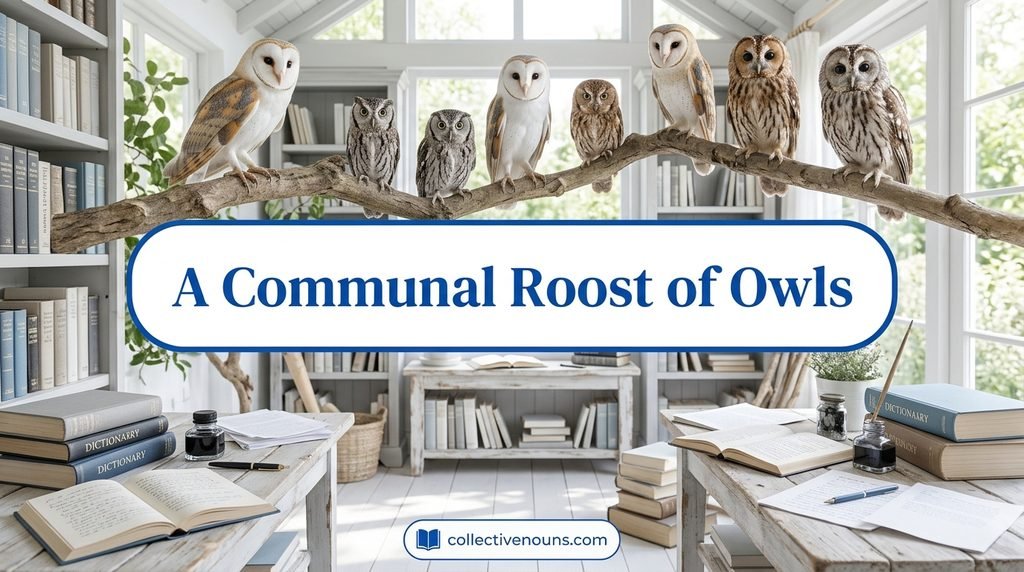
A communal roost of owls describes a place where several owls rest together, or the gathering of birds using that shared resting place. Communal roost is a descriptive wildlife expression, not a universally recognized, owl-specific collective noun.
A roost is a place where a bird rests, especially outside its main period of activity. The term is useful for describing owl behavior more precisely than a general phrase such as group of owls.
Why It Fits Owls
Although many owl species roost alone or in pairs, some species and populations are known to gather at communal roosts. Such gatherings can occur outside the breeding season and may involve sheltered trees or other suitable resting places. The reasons for communal roosting vary, and not every owl species behaves this way. Observing several owls at one roost does not mean that they cooperate in hunting or form a permanent social group. The phrase identifies a shared resting arrangement, making it useful for wildlife reports and discussions of animal behavior.
Examples
Example 1: A communal roost of owls formed in a sheltered area of the woodland.
Example 2: The researchers counted the owls using the communal roost.
Example 3: Several owls rested together at the communal roost during the day.
Example 4: The wildlife team monitored the communal roost without disturbing the birds.
Example 5: A suitable stand of trees provided shelter for the communal roost of owls.
Example 6: The survey revealed that several owls returned to the same roosting area.
Example 7: The conservation team protected the trees surrounding the communal roost.
Example 8: The communal roost offered the owls a sheltered place to rest.
Example 9: The observer recorded the number of birds visiting the communal roost each evening.
Example 10: The communal roost became less crowded when some owls moved to other resting sites.
How to Use Collective Nouns for Owls
Using owl collective nouns in English is straightforward once you understand how the words fit into a sentence.
- Place the group word before “of owls.” For example, a parliament of owls or a group of owls.
- Use “a” or “an” according to the following word’s sound. Say a parliament of owls, a group of owls, and an owl. The article depends on the sound of the word immediately following it.
- Use “of” to connect the group word with the animals. For example, a pair of owls identifies two birds.
- Choose a term that matches the situation. Use parliament for the traditional expression, pair for two birds, and family group when the relationship between the birds is relevant.
- Keep the meaning clear. If you do not know whether the owls are related or why they are gathered, a group of owls is a safe choice.
Here are a few examples:
- A parliament of owls appeared in the illustrated book.
- A group of owls rested in the trees.
- A pair of owls occupied the nesting territory.
- The family group of owls remained near the nest.
- Several owls used a communal roost during the day.
Remember that parliament is a traditional expression, while group, pair, family group, and communal roost describe different arrangements.
Should You Use a Singular or Plural Verb?
The correct verb depends on whether the collective noun is treated as a single unit or as several individual animals. British English often permits plural agreement when the members are considered separately, while American English generally favors singular agreement when a collective noun is treated as one unit.
For example:
- The parliament is featured in the storybook. The expression is treated as one group.
- The group is resting in the trees. The owls are considered a single gathering.
- The group are spreading out across the woodland. This plural agreement can occur in British English when the individual birds are emphasized.
- The pair is near the nest. The two owls are treated as one pair.
The verb should match the meaning you want to express and the conventions of the English variety you are using. In American English, the group is will usually sound more natural. In British English, the group are can be appropriate when the individuals are the focus.
With the ordinary plural noun owls, use a plural verb: The owls are resting in the trees.
Interesting Facts About Owls
Owls are fascinating birds with specialized adaptations for hunting, a wide range of habitats, and varied social habits. Although the expression parliament of owls gives them a shared group identity in traditional English, their actual behavior is best understood by looking at individual species.
Longevity
An owl’s lifespan depends on its species, body size, environment, and access to food. Small owl species generally have different life expectancies from larger species, and survival in the wild can be affected by predators, disease, accidents, and habitat changes. Some wild owls live for several years, while certain individuals survive much longer. Owls in human care may also live longer than wild birds when they receive appropriate veterinary care, a suitable diet, and protection from environmental dangers. However, there is no single lifespan that applies to every owl. For an accurate lifespan estimate, it is important to identify the species.
Unique Physiological Features
Owls have several remarkable physical features that help them survive. Their forward-facing eyes provide binocular vision, which helps them judge distances when locating prey. Unlike human eyes, an owl’s eyes are relatively fixed within their sockets, so many owls turn their heads to look in different directions.
Their hearing is also highly developed. In many species, the facial feathers form a facial disc that helps direct sound toward the ears. Some owls have asymmetrically positioned ear openings, which can help them locate prey by sound. These adaptations are especially useful when hunting in darkness or under vegetation.
Many owls also have feathers adapted for quiet flight. Specialized feather edges and soft feather surfaces help reduce the noise produced by their wings. Their hooked beaks and strong, curved talons allow them to seize and handle prey. These features make owls effective predators in their respective habitats.
Dietary Habits
Most owls are carnivores. Their diets commonly include small mammals, such as mice and voles, but the exact prey depends on the owl species, its size, its habitat, and what food is available. Some owls also eat insects, small birds, amphibians, reptiles, or fish.
Owls usually hunt alone rather than in coordinated groups. They may perch quietly before swooping toward prey or search for food while flying. Their excellent hearing and vision help them locate prey in low light. Many species swallow small prey whole or consume it in large pieces. They later regurgitate indigestible material, including bones and fur, in compact masses called pellets. Researchers can examine these pellets to learn more about an owl’s diet.
Social Behavior
Owl social behavior varies considerably. Many species are territorial and spend much of their time alone outside the breeding season. Others form breeding pairs, and parents may cooperate in protecting eggs and feeding their young.
Some owls gather at communal roosts, especially during certain seasons. These gatherings are not the same as permanent, highly organized flocks. The birds may share a suitable resting location without cooperating in hunting.
Owls also communicate through calls, body movements, and other signals. Their vocalizations can help individuals defend territories, attract mates, maintain contact with partners, or communicate with young. Because behavior differs across species, it is more accurate to describe the habits of a particular owl than to assume that all owls live in the same way.
Why Are Animal Collective Nouns So Interesting?
Animal collective nouns add color and variety to English. Instead of using only the word group, speakers can choose expressions such as a flock of birds, a herd of cattle, or the traditional parliament of owls.
Some expressions are closely connected to observable features of animal life. A flock, for example, often describes birds moving or feeding together. Other terms have developed through traditional vocabulary, literature, and cultural associations. The word parliament makes an owl gathering sound like an assembly of thoughtful individuals, reflecting the long-standing association between owls and wisdom in popular storytelling.
However, the appeal of a collective noun does not establish its scientific meaning or historical origin. It is not always possible to identify exactly when or why a particular expression began to be used.
For English learners, these words offer a useful lesson: language describes the world in both practical and imaginative ways. Some group names communicate a real arrangement, while others are traditional expressions that make writing more memorable.
Collective Nouns vs. Ordinary Group Words
Collective nouns and ordinary group words can both describe several animals, but they do not always carry the same meaning.
| Word | Typical Use | Example |
| Herd | Certain grazing mammals | A herd of deer |
| Pack | Certain animals that travel or hunt together | A pack of wolves |
| Flock | Birds or some other animals that gather together | A flock of geese |
| School | Fish and some aquatic animals moving together | A school of fish |
| Colony | Animals living or nesting in a shared area | A colony of penguins |
| Parliament | Traditional expression for owls | A parliament of owls |
| Group | A general term for several individuals | A group of owls |
The specific terms have different conventional uses, and their suitability depends on the animal and the situation.
For owls, parliament is the distinctive traditional expression, while group is the most straightforward general word. A pair describes two individuals, and a family group emphasizes a relationship between parents and offspring.
You do not need to memorize a special term to write correctly. The sentence “A group of owls rested in the trees” is perfectly grammatical and understandable. Choosing a more specific expression is useful when it adds relevant meaning or suits the style of your writing.
What Collective Nouns Tell Us About Owls
The collective noun parliament of owls illustrates how traditional language can shape the way people imagine wildlife. Owls are often associated with wisdom, mystery, and nighttime observation. The idea of a parliament builds on that image by suggesting a gathering of thoughtful birds.
Modern biological knowledge, however, gives us a more detailed understanding of owl behavior. Some species live mainly solitary lives, while others form breeding pairs, care for their young, or gather at communal roosts. Their behavior depends on their species, habitat, and circumstances.
This distinction is important for anyone studying animal vocabulary. Traditional language tells us how people describe or imagine animals, while scientific observation helps explain how animals actually live.
A collective noun should therefore be treated as a language expression, not as proof that an animal always behaves in a particular way. Learning both the expression and the biological facts makes the subject more useful for students, teachers, writers, and wildlife enthusiasts.
Frequently Asked Questions
What is the most common collective noun for owls?
The most common one is parliament of owls. It comes from traditional storytelling and appears in everyday conversation today.
Can you say flock of owls or group of owls?
Yes, you can use flock of owls or group of owls in spoken English. However, parliament of owls sounds more fun and fits animal group names best.
Why do owls have a special collective noun?
Many animal collective nouns began in medieval sources and hunting terms. Over time, writers and storytellers kept them alive as fanciful collective nouns.
Do owls really live in groups?
Most owl species live alone, so a gathering of owls is rare. Still, some owls share communal roosts or stay in family groups during the breeding season.
What are other collective nouns for birds and animals?
Common examples include a murmuration of birds, a pod of whales, a pack of dogs, and a clowder of cats. Each one shows how language and nature connect.
Conclusion
In short, collective nouns for owls add charm to English grammar and animal vocabulary words. The best-known term, parliament of owls, still leads, but a group of owls or a flock of owls works too. Since most owl species live alone, a true gathering of owls is rare. Next time you talk about animal group names, you can use them with confidence.
Share Your Review
Were these responses helpful? Rate below:

Ahmad Raza is a passionate language enthusiast and experienced writer with multiple years of experience exploring collective nouns and phrasal verbs. Through his work at colloctivenouns.com, he makes English grammar and vocabulary easier to understand with practical explanations, helpful examples, and engaging learning resources. He enjoys helping readers communicate more confidently and naturally. Explore his latest articles on colloctivenouns.com and continue your journey toward better English.