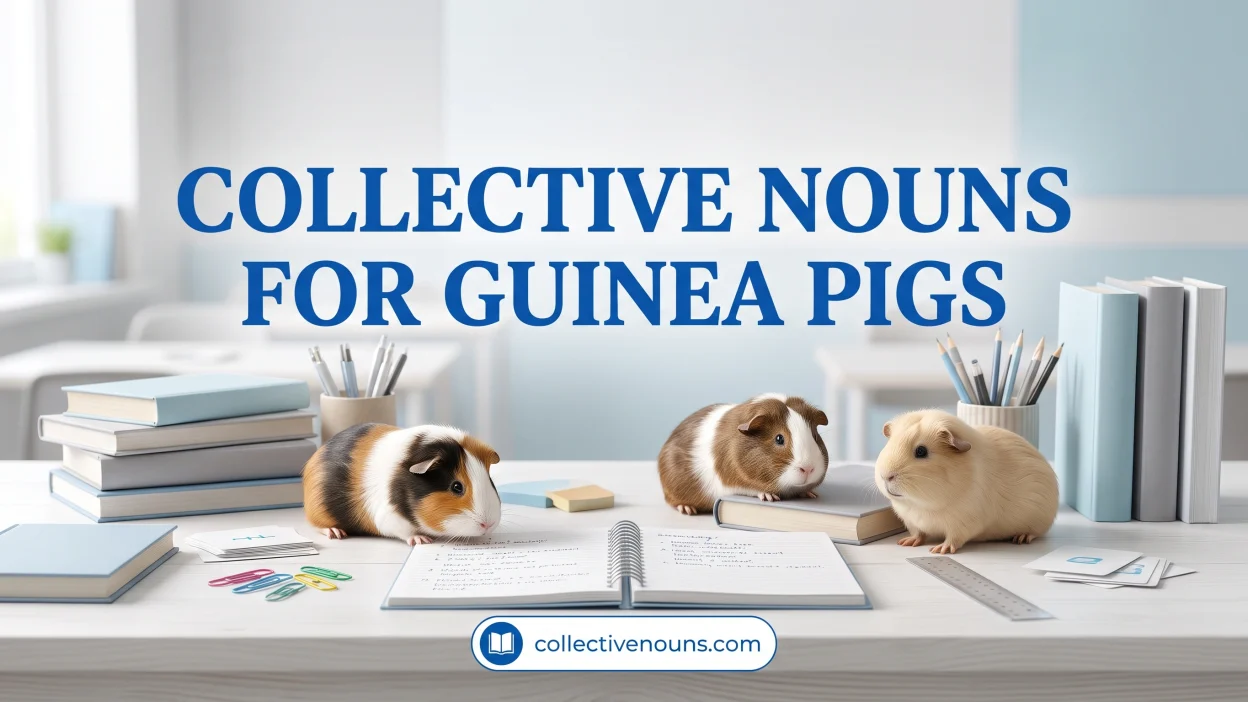
Collective nouns for guinea pigs help you name these adorable pets when they live together. The most common guinea pig collective noun is a herd of guinea pigs. Some people also say a colony of guinea pigs, which is a traditional group name with a warm feel. These sociable mammals have gentle personalities, so guinea pigs as a group make a lovely sight.
Next, this guide covers the collective noun meaning and shows example sentences in everyday English. You will also learn singular or plural verbs with herd is or herd are. Since guinea pig social habits shape their group identity, we explain how social interaction and companionship needs connect to these animal group names. Read on to build your animal vocabulary with confidence.
What Is a Collective Noun?
A collective noun is a word that refers to a group of people, animals, or things as a unit. It helps us describe several individuals without naming each one separately.
For example:
- A flock of birds flew across the sky.
- A herd of cattle grazed in the field.
- A team of players practiced before the match.
Collective nouns are useful because they make sentences shorter, clearer, and more expressive. Some are widely used in everyday English, while others belong mainly to traditional vocabulary, literature, or specialized contexts.
Animal group names can sometimes reflect how people observe animals, but a collective noun does not necessarily describe a scientifically defined social structure.
What Is a Group of Guinea Pigs Called?
Collective Noun Finder
Discover the special collective noun for any animal, along with an interesting fact about its name.
🐾 Animal
📖 Meaning
💡 Fun Fact
A group of guinea pigs is commonly called a herd of guinea pigs. The word herd is a recognized collective noun for these animals and is particularly suitable when describing several guinea pigs living or moving together.
The ordinary expression a group of guinea pigs is also correct and natural. For informal pet-care discussions, people may simply say a group or several guinea pigs.
There is no need to invent additional animal-specific terms to describe guinea pigs. Words such as pack, flock, and colony should not automatically be treated as standard alternatives for this species.
Quick Reference Table
| Type | Simple Example |
| Herd | A herd of guinea pigs |
| Group | A group of guinea pigs |
1. A Herd of Guinea Pigs
Meaning
A herd of guinea pigs is an expression used to describe several guinea pigs together. Herd is the main collective noun associated with guinea pigs and is a natural choice when describing their social lives. It is also widely used for other mammals, including cattle and elephants.
Why It Fits Guinea Pigs
Guinea pigs are social animals that generally benefit from living with compatible members of their own species. In suitable conditions, they may eat, rest, explore, and communicate near one another. A herd can include guinea pigs of different ages and sexes, depending on their housing and compatibility. However, the word does not specify a particular family structure or guarantee that every animal in the group gets along. Guinea pigs still need sufficient space, suitable resources, and careful introductions when unfamiliar animals are brought together.
Examples
Example 1: A herd of guinea pigs explored the spacious enclosure.
Example 2: The children watched a herd of guinea pigs eating hay.
Example 3: A small herd of guinea pigs rested in the shade.
Example 4: The caretaker checked the herd before feeding time.
Example 5: A herd of guinea pigs moved toward the fresh vegetables.
Example 6: The veterinarian examined several members of the herd.
Example 7: A herd of guinea pigs made soft noises as they explored their surroundings.
Example 8: The shelter provided a clean, comfortable home for the herd.
Example 9: One guinea pig stayed close to the others in the herd.
Example 10: The herd settled down after an active morning.
2. A Group of Guinea Pigs
Meaning
A group of guinea pigs is a simple, general expression for two or more guinea pigs. Although group is not specific to this animal, it is completely correct and often the clearest choice in everyday English.
Why It Fits Guinea Pigs
The word group works well when the exact social arrangement of the guinea pigs is unknown or unimportant. It can describe pets living together, animals being examined at a veterinary clinic, or guinea pigs observed during a lesson about mammals. Unlike a more specialized collective noun, group does not suggest a particular type of animal society. This makes it especially useful for students, teachers, pet owners, and English learners who want to describe guinea pigs accurately without relying on uncommon vocabulary.
Examples
Example 1: A group of guinea pigs gathered around the hay rack.
Example 2: We saw a group of guinea pigs at the animal shelter.
Example 3: The teacher introduced a group of guinea pigs during the lesson.
Example 4: A group of guinea pigs rested in separate hiding places.
Example 5: The children drew pictures of a group of guinea pigs.
Example 6: A group of guinea pigs shared a spacious enclosure.
Example 7: The volunteer observed the group during feeding time.
Example 8: Each guinea pig in the group had access to fresh water.
Example 9: The group became more active when the caretaker arrived.
Example 10: A group of guinea pigs can make an interesting subject for an animal-behavior project.
3. Using “Herd” to Describe Guinea Pig Behavior
Meaning
The word herd can describe guinea pigs when the writer wants to emphasize that several animals are living or behaving together. It is an established animal-group term rather than a special word that identifies a precise number of guinea pigs.
Why It Fits Guinea Pigs
Guinea pigs communicate through vocalizations, body movements, and other behaviors. They may follow one another, approach shared feeding areas, or rest near familiar companions. Describing them as a herd can help readers picture several animals interacting in the same space. Nevertheless, their behavior varies according to personality, age, health, environment, and social compatibility. A herd may contain animals that interact frequently as well as individuals that prefer some distance. The collective noun describes the group; it does not replace a careful account of what the animals actually do.
Examples
Example 1: The herd became alert when it heard the sound of a food container.
Example 2: A herd of guinea pigs approached the hay basket.
Example 3: The caretaker observed the herd’s behavior during the afternoon.
Example 4: The herd rested while the room remained quiet.
Example 5: A herd of guinea pigs explored tunnels placed inside their enclosure.
Example 6: The herd showed interest when fresh vegetables were offered.
Example 7: One animal moved away while the rest of the herd continued eating.
Example 8: The herd had several hiding places where its members could feel secure.
Example 9: The researcher recorded the herd’s interactions without disturbing the animals.
Example 10: Watching the herd helped the students learn about guinea pig communication.
See Also: Collective Nouns for Arrows
4. Using “Group” in Pet Care and Animal Education
Meaning
Group is a flexible noun that refers to several guinea pigs considered together. It is particularly useful in practical writing because it makes no assumptions about the animals’ relationships, ages, or behavior.
Why It Fits Guinea Pigs
Pet-care instructions often discuss guinea pigs collectively when explaining feeding, housing, hygiene, and veterinary care. For instance, a caretaker might describe the amount of hay provided to a group without suggesting that every animal eats at the same time. Teachers can also use group when introducing students to the species or comparing the behavior of different animals. When discussing guinea pigs that share a home, it is still important to consider individual needs. A group label does not mean that every animal has identical dietary requirements, health needs, or social preferences.
Examples
Example 1: The group received fresh hay every day.
Example 2: A group of guinea pigs needs enough room to move comfortably.
Example 3: The students recorded the weight of each guinea pig in the group.
Example 4: The caretaker cleaned the group’s water bottles.
Example 5: A group of guinea pigs explored the enrichment toys.
Example 6: The shelter arranged veterinary checks for the group.
Example 7: The children learned how the group communicated through different sounds.
Example 8: Every guinea pig in the group had access to a suitable hiding place.
Example 9: The group was monitored for changes in appetite and activity.
Example 10: The animal-care guide explained how to introduce a new guinea pig safely.
5. Choosing Between “Herd” and “Group” of Guinea Pigs
Meaning
Both herd and group can describe several guinea pigs. Herd is the more animal-specific collective noun, while group is a general word that works in almost any context. Neither expression identifies an exact number of animals.
Why It Fits Guinea Pigs
Choosing between these terms depends on the purpose of the sentence. Use herd when discussing guinea pigs together as animals, particularly in descriptions of their social behavior. Use group when you want neutral, straightforward wording, such as in classroom activities, pet-care instructions, or scientific observations. Both expressions are grammatically correct. Writers should avoid replacing them with less-established terms simply to make their vocabulary sound unusual. Clear language is more valuable than an obscure collective noun that readers may not recognize.
Examples
Example 1: A herd of guinea pigs gathered near the feeding area.
Example 2: The group had access to clean water throughout the day.
Example 3: The keeper watched the herd while preparing their food.
Example 4: Each guinea pig in the group was checked for signs of illness.
Example 5: A herd of guinea pigs explored the enclosure together.
Example 6: The students divided their observations into separate groups for comparison.
Example 7: The herd rested after finishing its meal.
Example 8: A group of guinea pigs can include animals with different personalities.
Example 9: The caretaker recorded how the herd responded to a new hiding place.
Example 10: The report used the word group whenever the animals’ social relationships were not relevant.
How to Use Collective Nouns for Guinea Pigs
Using collective nouns in English is straightforward once you understand the sentence structure. The collective noun identifies the group, and the phrase beginning with of tells readers which animals belong to it.
Follow these simple rules:
- Use a herd or a group when referring to one group for the first time.
- Use of to connect the collective noun to the animals.
- Use a before herd and group because both words begin with consonant sounds.
- Choose a singular or plural verb according to whether you are treating the group as one unit or emphasizing its individual members.
Examples:
- A herd of guinea pigs is resting in the enclosure.
- A group of guinea pigs is eating fresh hay.
- The herd has several hiding places.
- The guinea pigs in the group are behaving differently.
- Two groups of guinea pigs are being observed by the students.
Notice that a herd refers to one group, while two herds refers to more than one group.
Should You Use a Singular or Plural Verb?
A collective noun can take a singular or plural verb, depending on the variety of English and the intended meaning.
In American English, collective nouns are commonly treated as singular when the group is considered a unit. British English more readily allows plural agreement when the members are considered individually.
For example:
- The herd is resting. The guinea pigs are being considered as one group.
- The herd are moving in different directions. This construction emphasizes the individual animals and is more natural in varieties of English that allow plural agreement with collective nouns.
- The guinea pigs are eating. The plural noun guinea pigs takes a plural verb.
- The group is eating. The group is treated as one unit.
For English learners, the simplest approach is to use a singular verb when treating herd or group as one unit. This is especially straightforward in American English.
Read More: Collective Nouns for Arrows
Interesting Facts About Guinea Pigs
Longevity
Guinea pigs commonly live for around five to seven years, although individual lifespans vary. Some live longer, while others have shorter lives because of illness, genetics, or other circumstances. Pet guinea pigs depend on appropriate nutrition, clean housing, daily observation, and suitable veterinary care. Their lifespan should not be confused with that of hamsters, which generally have much shorter lives. A guinea pig’s age, appetite, weight, activity, and general condition can all help a caretaker monitor its well-being.
Unique Physiological Features
Guinea pigs (Cavia porcellus) are small, sturdy rodents with compact bodies, short legs, rounded heads, and dense fur. Their coats come in many colors and patterns, depending on the breed. They have no prominent external tail, which contributes to their rounded appearance.
One of their most important biological features is their continuously growing teeth. Their incisors grow throughout life, and appropriate chewing helps maintain normal tooth wear. Their cheek teeth also continue to grow, so dental health is important.
Guinea pigs are also born relatively well developed. Unlike many other small mammals, newborns usually have fur, open eyes, and the ability to move around soon after birth. This is known as being precocial.
Another distinctive feature is their need for dietary vitamin C. Like humans, guinea pigs cannot produce enough vitamin C on their own and must obtain it from their diet. A deficiency can lead to serious health problems.
Dietary Habits
Guinea pigs are herbivores, meaning they eat plant material. In captivity, good-quality grass hay should make up the main part of their diet. Hay supplies fiber and supports normal digestion and tooth wear. Fresh water must always be available.
Suitable fresh vegetables can provide additional nutrients, including vitamin C. Guinea pigs may also eat specially formulated guinea pig pellets, provided the food is appropriate for their age and nutritional needs. Fruits can be offered in small amounts as occasional treats because they contain natural sugars.
A balanced diet is essential. Guinea pigs should not be fed meat, dairy products, or foods intended primarily for carnivorous pets. Their digestive systems are adapted to a plant-based diet, and sudden dietary changes can cause problems.
Social Behavior
Guinea pigs are naturally social animals and generally do well with compatible companions of their own species. They communicate using a variety of sounds, including squeaks, purr-like vocalizations, and warning noises. Some produce loud wheeking sounds when they anticipate food or recognize familiar routines.
They may follow one another, rest nearby, investigate shared spaces, or display dominance behaviors. However, social living does not mean that every pairing will work. Personality, sex, age, available space, and the introduction process can affect compatibility.
Guinea pigs also need places to hide and opportunities to move away from other animals when they want privacy. Providing multiple feeding and hiding areas can help reduce competition. Understanding these needs makes the collective noun herd more meaningful: it describes animals that can share a social environment while retaining their individual behaviors and preferences.
Why Are Animal Collective Nouns So Interesting?
Animal collective nouns show how English uses compact expressions to describe the natural world. Words such as herd, flock, pack, and school make language more vivid and help readers picture animals in different settings.
Some animal group names have long histories in traditional English vocabulary, hunting literature, and storytelling. Others are simply ordinary words that have become associated with particular animals through common usage. The origin and popularity of a term can differ, so it is important not to assume that every unusual expression is a widely accepted or scientifically meaningful name.
For guinea pigs, herd is a useful collective noun, while group is a clear everyday alternative. These words help describe several animals without requiring a lengthy explanation. At the same time, knowledge of guinea pig behavior adds depth to the vocabulary. Their social interactions, feeding routines, and communication make them interesting subjects for both language learning and animal education.
Collective Nouns vs. Ordinary Group Words
Collective nouns and ordinary group words both help us refer to multiple animals, but their meanings and typical uses can differ.
| Word | General Meaning | Example |
| Herd | A group of certain mammals | A herd of guinea pigs |
| Group | Several individuals considered together | A group of guinea pigs |
| Pack | A group commonly associated with certain social or hunting animals | A pack of wolves |
| Flock | A group of birds or certain other animals | A flock of sheep |
| School | A group of fish or other aquatic animals in common usage | A school of fish |
| Colony | A group living together in a shared area or organized community | A colony of ants |
The word herd is more specific than group, but both are suitable for guinea pigs. The other words in the table illustrate general English usage and should not be treated as interchangeable terms for guinea pigs.
Most importantly, “a group of guinea pigs” is always a reasonable grammatical option when you simply want to describe several animals together. You do not need to memorize an obscure term to write correctly.
See Also: Phrasal Verbs for Cut Down
What Collective Nouns Tell Us About Guinea Pigs
Collective nouns can offer clues about how people have traditionally described animals. A word such as herd encourages readers to picture several mammals together, while flock often brings birds to mind. These associations make English more expressive and can help readers imagine a scene quickly.
However, traditional language and modern biological knowledge are not the same thing. A collective noun does not establish how an animal must behave, how many individuals belong together, or whether a group has a particular social structure.
Guinea pigs illustrate this distinction well. Calling several guinea pigs a herd is useful English, but their actual relationships depend on their environment, individual personalities, and compatibility. Their social needs are better understood through observation and animal-care knowledge than through vocabulary alone.
Learning animal group names is therefore most useful when grammar and biology support one another. The words give us a convenient way to describe animals, while scientific understanding helps us describe them accurately.
Frequently Asked Questions
What is the collective noun for guinea pigs?
The most common guinea pig collective noun is a herd. A herd of guinea pigs is the term most people use.
Can you call a group of guinea pigs a colony?
Yes, you can. A colony of guinea pigs is also a traditional group name, though it is less common than herd.
Is it “herd is” or “herd are”?
Both work, depending on your meaning. Use singular collective nouns with “is” for one unit, and plural collective nouns with “are” for individual animals.
Why do guinea pigs need to live in a group?
They are sociable mammals with strong companionship needs. Living together supports their social interaction and animal social behavior.
Conclusion
In short, a herd of guinea pigs is the most common guinea pig collective noun, while a colony of guinea pigs also works well. These sociable mammals thrive on social interaction and companionship needs, so their group identity matters. Now you can use these animal group names with confidence and match singular or plural verbs to your meaning. Keep building your animal vocabulary, and enjoy your adorable pets together.
Share Your Review
Were these responses helpful? Rate below:
Ahmad Raza is a passionate language enthusiast and experienced writer with multiple years of experience exploring collective nouns and phrasal verbs. Through his work at colloctivenouns.com, he makes English grammar and vocabulary easier to understand with practical explanations, helpful examples, and engaging learning resources. He enjoys helping readers communicate more confidently and naturally. Explore his latest articles on colloctivenouns.com and continue your journey toward better English.