
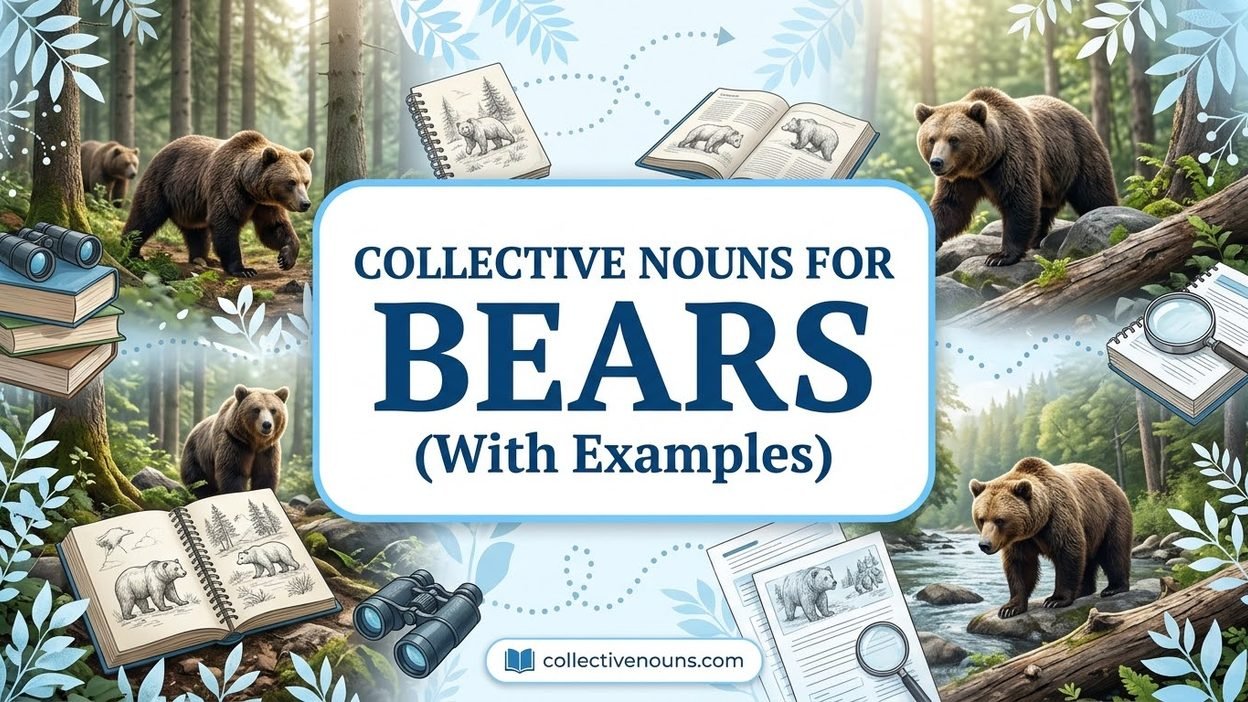
The English language uses special words to describe groups of animals, and bears have several interesting collective nouns associated with them. A collective noun is a word that refers to a group of people, animals, or things as one unit. For example, we say a flock of birds, a herd of cattle, or a team of players.
When discussing bears, expressions such as a sloth of bears and a sleuth of bears appear in traditional animal vocabulary, while a group of bears is a straightforward choice in everyday English. However, these specialized terms are not equally common, and their use does not mean bears normally live together in large social groups.
Most bears are largely solitary outside particular situations, such as a mother raising her cubs or several bears gathering where food is plentiful. This article explores bear collective nouns, natural example sentences, grammar rules, and fascinating facts about bear behavior, habitats, diets, and physical features.
What Is a Collective Noun?
A collective noun is a word used to name a collection of people, animals, or things. Instead of describing every member separately, it gives the collection a single group name.
Collective nouns make English more concise and expressive. They help readers picture a team working together, a flock moving across the sky, or a herd grazing in a field.
Here are three simple examples:
- A flock of birds flew over the garden.
- A herd of cattle grazed in the meadow.
- A team of players practiced before the match.
Some collective nouns are widely used in everyday conversation, while others belong mainly to traditional vocabulary, literature, or specialized animal terminology. Knowing the difference helps English learners choose words that sound natural and communicate their meaning clearly.
What Is a Group of Bears Called?
Collective Noun Finder
Discover the special collective noun for any animal, along with an interesting fact about its name.
🐾 Animal
📖 Meaning
💡 Fun Fact
A group of bears is traditionally called a sloth of bears or a sleuth of bears. Both expressions are recognized in traditional English animal vocabulary, but neither is necessary in ordinary conversation. The neutral phrase a group of bears is clear, natural, and suitable in almost any context.
The word sloth here refers to a traditional group name, not the slow-moving mammal called a sloth. Similarly, sleuth is an unusual group term rather than a description of bears acting like detectives.
These specialized expressions should be understood as traditional vocabulary, not scientific classifications. Bears are generally solitary animals, although their behavior varies by species, season, food availability, and family relationships.
Quick Reference Table
| Type | Simple Example |
| Sloth | A sloth of bears |
| Sleuth | A sleuth of bears |
1. A Sloth of Bears
Meaning
A sloth of bears is a traditional collective noun for a group of bears. It is an unusual expression and is much less familiar in everyday English than a phrase such as a group of bears. In this context, sloth is a group name, not a reference to the unrelated mammal.
Why It Fits Bears
The expression is part of traditional English animal vocabulary, but it should not be taken as a scientific description of bear behavior. Bears are not generally known for living in permanent groups. Many species spend much of their time alone while searching for food, resting, or moving through their territories. However, several bears may gather around a productive feeding area, such as a river during a salmon run or a place with abundant seasonal food. The term sloth can describe such a collection in traditional writing, although the simpler phrase group of bears is usually clearer for modern readers.
Example
Example 1: A sloth of bears appeared near the river during the salmon run.
Example 2: The wildlife guide described a sloth of bears in the traditional animal vocabulary.
Example 3: A sloth of bears gathered near the feeding area in the nature documentary.
Example 4: The children learned the expression sloth of bears during their English lesson.
Example 5: A photographer watched a sloth of bears from a safe observation point.
Example 6: The writer included a sloth of bears in a story about a northern forest.
Example 7: We read about a sloth of bears in an old book of animal expressions.
Example 8: A sloth of bears appeared in the educational display at the wildlife center.
Example 9: The teacher explained that a sloth of bears is a traditional term rather than a scientific classification.
Example 10: In the vocabulary exercise, students used sloth of bears in an original sentence.
2. A Sleuth of Bears
Meaning
A sleuth of bears is another traditional collective noun associated with bears. The word sleuth is more commonly connected with a detective or investigator in modern English. As an animal group name, it is unusual and is best treated as a traditional or literary expression rather than a common everyday term.
Why It Fits Bears
The expression can be used when writing about several bears in a shared setting, but it does not establish that bears naturally form organized groups. Bears often search for food individually, using their powerful sense of smell to locate berries, roots, insects, fish, and other suitable food sources. Several individuals may visit the same area when food is abundant, especially when environmental conditions attract them to a reliable resource. In such a situation, sleuth of bears may add variety to descriptive writing. In wildlife reports and ordinary conversation, however, a group of bears is generally more direct and less likely to confuse readers.
Example
Example 1: A sleuth of bears appeared in the old wildlife story.
Example 2: The author used sleuth of bears to introduce a scene in the forest.
Example 3: Our vocabulary book included a sleuth of bears among its traditional animal expressions.
Example 4: The teacher asked the class to explain the meaning of a sleuth of bears.
Example 5: A sleuth of bears featured in the children’s illustrated story about mountain wildlife.
Example 6: The writer chose a sleuth of bears to give the passage a traditional tone.
Example 7: During the lesson, students compared sleuth of bears with the ordinary phrase group of bears.
Example 8: The nature club discussed whether a sleuth of bears would sound natural in a scientific report.
Example 9: The editor replaced sleuth of bears with group of bears to make the wildlife article easier to understand.
Example 10: She remembered the expression sleuth of bears because it was unusual.
3. A Group of Bears
Meaning
A group of bears is the clearest general expression for two or more bears considered together. Although group is not a bear-specific collective noun, it is an ordinary, widely understood English word that works in almost any context.
Why It Fits Bears
Bears are mostly solitary animals, so the word group is useful when several individuals are observed in the same place without implying that they form a permanent social unit. For example, brown bears may gather at productive fishing locations, while other bears may be seen near food sources or in managed wildlife settings. The members of such a group may be unrelated and may not cooperate. This neutral phrase is especially helpful in wildlife education, news reports, school assignments, and conversations where accuracy matters more than using an unusual traditional expression.
Example
Example 1: A group of bears crossed the river one at a time.
Example 2: The researchers observed a group of bears near the salmon-rich stream.
Example 3: A group of bears appeared on the camera footage overnight.
Example 4: We spotted a group of bears from the designated viewing area.
Example 5: The documentary showed a group of bears searching for food along the riverbank.
Example 6: A group of bears visited the same feeding area during the autumn.
Example 7: The wildlife team recorded a group of bears moving through the forest.
Example 8: Visitors watched a group of bears from behind the zoo’s safety barrier.
Example 9: A group of bears gathered where food was plentiful.
Example 10: The report described a group of bears without suggesting that they lived together permanently.
4. A Family Group of Bears
Meaning
A family group of bears is an ordinary descriptive expression for related bears, particularly a mother and her cubs. It is not a specialized traditional collective noun like sloth or sleuth, but it accurately describes an important type of bear grouping.
Why It Fits Bears
A mother bear and her cubs form one of the clearest examples of bears living together. Depending on the species and circumstances, a mother provides protection and helps her young develop the skills they need to survive. Cubs may remain with their mother for an extended period before becoming independent. This relationship is different from a gathering of unrelated adult bears at a food source. Using family group makes the relationship clear and helps readers understand that bear social behavior varies with age, reproduction, and individual circumstances. The exact duration of maternal care differs among bear species.
Example
Example 1: A family group of bears moved through the forest with the cubs close to their mother.
Example 2: The ranger spotted a family group of bears from a safe distance.
Example 3: A family group of bears rested in a quiet area away from human activity.
Example 4: The wildlife camera recorded a family group of bears crossing a woodland trail.
Example 5: A family group of bears searched for berries in the forest.
Example 6: The mother led her family group of bears toward a sheltered area.
Example 7: The documentary followed a family group of bears as the cubs explored their surroundings.
Example 8: Researchers observed a family group of bears without disturbing the animals.
Example 9: A family group of bears disappeared among the trees.
Example 10: The nature guide explained how a family group of bears differs from a temporary gathering of unrelated adults.
5. A Gathering of Bears
Meaning
A gathering of bears is a descriptive phrase for bears that come together in the same location. It is not a unique or formally established bear collective noun. Instead, it uses the ordinary noun gathering to describe what the animals are doing.
Why It Fits Bears
Although bears generally lead solitary lives, they can gather when circumstances bring them to the same place. Food is an important example. In some regions, brown bears congregate around rivers during salmon runs, when fish provide an abundant source of nutrition. Bears may also visit areas with plentiful berries or other seasonal foods. Such gatherings do not necessarily mean that the animals have stable social bonds or cooperate as a group. The phrase gathering of bears is useful because it describes the observable situation without making assumptions about the relationships between the animals.
Example
Example 1: A gathering of bears formed near the river during the salmon run.
Example 2: The photographer recorded a gathering of bears from an approved observation point.
Example 3: A gathering of bears appeared near the food-rich stream.
Example 4: The documentary explained why a gathering of bears may occur in a place with abundant fish.
Example 5: A gathering of bears visited the same area during the berry season.
Example 6: The researchers studied a gathering of bears without approaching the animals.
Example 7: A gathering of bears became visible when the morning mist lifted.
Example 8: The ranger explained that a gathering of bears does not necessarily represent a permanent social group.
Example 9: A gathering of bears moved away after the available food became scarce.
Example 10: The wildlife report described a gathering of bears near the river without assigning the animals a specific social relationship.
See Also: Phrasal Verbs for Cover Up
How to Use Collective Nouns for Bears
Collective nouns follow the same basic sentence rules as other English nouns. To use them correctly, place the group name in the sentence and connect it to the animals with of.
For example:
- A sloth of bears appeared near the river.
- A sleuth of bears featured in the traditional story.
- A group of bears crossed the forest trail.
- A family group of bears rested beneath the trees.
- A gathering of bears formed near the feeding area.
Use a before a singular group expression that begins with a consonant sound. Both sloth and sleuth begin with consonant sounds, so we say a sloth of bears and a sleuth of bears.
The word of connects the collective noun with the animals being described. In a group of bears, the noun group identifies the collection, while bears tells us which animals belong to it.
A collective noun can take a singular or plural verb depending on the intended meaning and the variety of English being used. The next section explains this distinction.
Should You Use a Singular or Plural Verb?
The verb used with a collective noun depends on whether the group is being treated as a single unit or as individual members. English varieties also differ in their preferences.
Singular verb: Use a singular verb when the group is viewed as one unit.
- A group of bears is visible in the distance.
- The family group is moving through the forest.
- The gathering was recorded by a wildlife camera.
Plural verb: In varieties of English that commonly allow plural agreement with collective nouns, a plural verb can emphasize the members acting separately.
- The group of bears are moving in different directions.
- The family group are spreading out to search for food.
In American English, singular agreement is generally preferred when a collective noun is the grammatical subject. British English more readily allows plural agreement when the individual members are in focus.
For learners, a useful starting point is to use a singular verb when describing the group as one unit. Choose the form that fits the sentence and remain consistent with the variety of English you are writing.
Interesting Facts About Bears
Longevity
Bears can live for many years, but their lifespan depends on the species, environment, health, and access to food. In the wild, bears face challenges such as food shortages, disease, injuries, competition, and human activity. These risks can affect how long an individual survives. Bears in managed care may live longer because they receive regular food, veterinary treatment, and protection from some natural dangers, although lifespan varies considerably between individuals and facilities.
Different bear species also have different life histories. Black bears, brown bears, polar bears, and giant pandas do not all have identical growth patterns or lifespans. Therefore, it is better to consider the species when discussing bear longevity rather than assuming that every bear lives for the same number of years.
Unique Physiological Features
Bears have powerful bodies and several physical adaptations that help them survive in different environments. Their thick fur provides insulation, while a layer of body fat helps many species retain warmth. Polar bears are especially well adapted to Arctic conditions, with dense fur and substantial body fat that help them withstand cold temperatures.
Most bears have strong limbs, large paws, and claws that support activities such as digging, climbing, handling food, or moving across rough ground. Claw length and shape vary among species. For example, brown bears have long claws useful for digging, while black bears are capable climbers.
A bear’s sense of smell is particularly important. Bears use scent to locate food and gather information about their surroundings. Their hearing also helps them detect sounds, and their eyesight supports movement through their habitats. Together, these senses help bears find resources and respond to potential threats.
See Also: Collective Nouns for Tigers
Dietary Habits
Most bears are omnivores, meaning they eat both plant and animal foods. However, their diets differ significantly by species, location, and season. Many bears eat berries, roots, grasses, insects, nuts, and other plant or animal matter. Some also feed on fish, small mammals, or the remains of larger animals.
Brown bears may consume large quantities of salmon where these fish are available. Black bears often eat berries, nuts, insects, and other foods that change with the seasons. Polar bears depend heavily on animal prey, especially seals, because they live in an Arctic environment where suitable plant foods are limited.
Giant pandas are an important exception to the general picture of bear diets. Although they belong to the bear family, they feed primarily on bamboo. This variety shows how different bear species have adapted to the resources available in their habitats.
Social Behavior
Bears are generally solitary animals, but that does not mean they never interact with one another. Their social behavior changes with the circumstances. Mothers care for their cubs, adult bears meet during breeding periods, and several individuals may gather in areas where food is abundant.
A mother bear protects her cubs and helps them learn important survival behaviors. Depending on the species, cubs may stay with her for a substantial period before becoming independent. During this time, the family relationship is an important part of the young bears’ development.
Adult bears may communicate through scent marking, vocalizations, body posture, and other signals. Some interactions involve competition, particularly around food or potential mates. Others are relatively peaceful when resources are plentiful. These behaviors explain why the phrase group of bears must be used carefully: seeing several bears together does not necessarily mean they form a permanent social group.
Why Are Animal Collective Nouns So Interesting?
Animal collective nouns make English vocabulary colorful and memorable. Words such as flock, herd, and school give readers a quick way to picture different collections of animals. Traditional expressions such as a sloth of bears and a sleuth of bears add another layer of interest because they are less familiar than everyday group words.
Some animal group names are connected with long-standing traditions of hunting, literature, and storytelling. Others reflect recognizable features of animals or the way people have described them over time. However, the origin of a particular expression is not always certain, and it is important not to invent a historical explanation simply because a word seems meaningful.
Collective nouns also demonstrate how language changes. A term may remain in dictionaries or traditional vocabulary lists even when most speakers rarely use it. Another expression may become familiar through books, education, or popular culture.
For bears, these distinctions are especially useful. The traditional names are interesting to learn, but they should not be confused with scientific descriptions of bear society. Understanding both the vocabulary and the animal helps readers appreciate English without losing sight of wildlife facts.
Collective Nouns vs. Ordinary Group Words
Collective nouns and ordinary group words can both describe collections, but they differ in how specific or traditional they are.
| Word | Typical Use | Example |
| Herd | Commonly used for certain grazing or large land animals | A herd of deer |
| Pack | Commonly used for certain social or hunting animals | A pack of wolves |
| Flock | Commonly used for birds and some other animals | A flock of geese |
| School | Commonly used for fish and some other aquatic animals | A school of fish |
| Colony | Used for animals living or breeding together in a shared area | A colony of penguins |
| Sloth | A traditional collective noun for bears | A sloth of bears |
| Sleuth | Another traditional collective noun associated with bears | A sleuth of bears |
| Group | A general term for several individuals | A group of bears |
The main difference is that some words are strongly associated with particular animals, while group works broadly across many contexts. A pack of wolves is a familiar expression, whereas a group of wolves is also grammatically correct.
Likewise, a group of bears is perfectly acceptable English even when a writer knows the traditional terms sloth and sleuth. A general word may be preferable when the specific term is unfamiliar or when scientific clarity is important.
Remember that a collective noun does not always describe the animals’ actual social structure. A colony may refer to animals living or breeding in the same area, while a group simply identifies individuals considered together. The best choice depends on what you want to communicate.
What Collective Nouns Tell Us About Bears
Collective nouns provide clues about how people have traditionally described animals. A term such as sloth of bears belongs to English’s rich collection of animal group names, while the ordinary expression group of bears communicates the same broad idea without relying on specialized vocabulary.
However, traditional language and modern biology serve different purposes. A collective noun is a linguistic label, not a scientific rule about how animals behave. Calling several bears a sleuth does not mean that they cooperate like a pack or maintain a permanent social unit.
Modern wildlife knowledge shows that most bears are largely solitary, with important exceptions involving mothers and cubs, breeding interactions, and temporary gatherings around food. Their behavior depends on species, habitat, season, and available resources.
This distinction is useful for both English learners and wildlife enthusiasts. Learning animal group names builds vocabulary and improves descriptive writing, while studying the animals themselves helps us understand the limits of those expressions. Language can preserve traditional ways of seeing wildlife, but careful observation helps us understand the animals more accurately.
Frequently Asked Questions
What is a group of bears called?
A group of bears is traditionally called a sloth of bears or a sleuth of bears. In everyday English, a group of bears is the clearest and most widely understandable expression.
What is the most common collective noun for bears?
Group is the most straightforward choice in everyday conversation and general wildlife writing. Sloth and sleuth are traditional animal group names, but they are uncommon in ordinary speech.
Can I use “a group of bears” in English?
Yes. A group of bears is grammatically correct and natural. You do not need to use a specialized collective noun to describe several bears in the same place.
Are animal collective nouns always commonly used?
No. Some collective nouns, such as flock of birds and herd of cattle, are familiar in everyday English. Others, including sloth of bears and sleuth of bears, are traditional expressions that many speakers rarely use.
Conclusion
Learning the collective nouns for bears introduces us to both traditional English vocabulary and the fascinating world of wildlife. The expressions a sloth of bears and a sleuth of bears are traditional group names, while a group of bears remains a clear and practical choice for everyday communication. A family group of bears and a gathering of bears are also useful descriptive expressions when explaining particular situations.
Bears are remarkable animals with powerful bodies, an excellent sense of smell, and diets that vary according to species and habitat. Although most bears are largely solitary, mothers care for their cubs, and adults sometimes gather where food is plentiful. These behaviors remind us that a traditional group name does not necessarily describe an animal’s social life.
By studying collective nouns, grammar, and animal facts together, students can develop stronger vocabulary while gaining a deeper appreciation of nature. English becomes more meaningful when we understand both the words we use and the wildlife those words describe.
Share Your Review
Were these responses helpful? Rate below:

Naeem Raza is a passionate language enthusiast and experienced writer with multiple years of experience exploring collective nouns and phrasal verbs. He enjoys making English grammar and vocabulary easier to understand through clear explanations, practical examples, and engaging educational content. At colloctivenouns.com, Naeem shares helpful language resources designed to build readers’ confidence and communication skills. Explore more of his content to make learning English enjoyable and rewarding.