Moose are among the largest members of the deer family, and their behavior makes them an interesting subject for learning collective nouns. A collective noun is a word that describes a group of people, animals, or things. In English, we use expressions such as a herd of cattle or a flock of birds to describe several individuals together.
When discussing the collective noun for moose, the word herd is a useful and widely understood choice, although moose usually live alone rather than in permanent groups. Other expressions, such as group or gathering, can also describe several moose in the same place.
These words help us communicate clearly while exploring animal vocabulary, grammar, and wildlife. In this article, you will learn how to use group names for moose, understand their social behavior, and discover fascinating facts about their physical features, habitat, diet, and lifespan.
What Is a Collective Noun?
A collective noun is a word used to name a collection of people, animals, or things as a group. It allows us to describe several individuals without naming each one separately.
Collective nouns make English more concise and expressive. They are useful in everyday conversation, writing, storytelling, and educational texts.
Here are three simple examples:
- A flock of birds flew over the trees.
- A herd of cattle grazed in the field.
- A team of players practiced before the match.
Some animal group names, such as herd and flock, are common in everyday English. Others are traditional or literary expressions that may not be familiar to every speaker. Understanding this difference helps learners choose natural and accurate words.
What Is a Group of Moose Called?
Collective Noun Finder
Discover the special collective noun for any animal, along with an interesting fact about its name.
🐾 Animal
📖 Meaning
💡 Fun Fact
A group of moose can be called a herd of moose, although a group of moose is also perfectly correct. The word herd is a familiar collective noun for large hoofed mammals.
However, moose are generally solitary animals. Unlike species that regularly travel in large herds, adult moose usually forage and move independently outside the breeding season. Several moose may gather temporarily where food is available or during particular seasonal activities, but these gatherings do not necessarily represent a stable social group.
Quick Reference Table
| Type | Simple Example |
| Herd | A herd of moose |
| Group | A group of moose |
| Gathering | A gathering of moose |
1. A Herd of Moose
Meaning
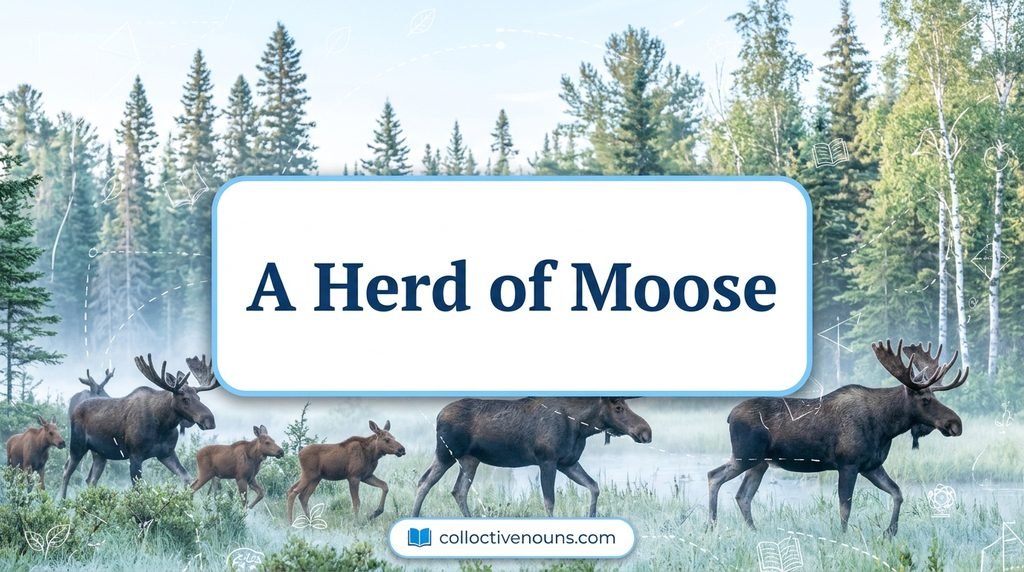
A herd of moose is an expression for several moose considered together. Herd is a familiar collective noun used for many large grazing or browsing mammals. It is understandable in ordinary English, but it should not suggest that moose always live in herds. Moose are mostly solitary, and a group may form temporarily rather than remain together as a permanent social unit.
Why It Fits Moose
The word herd can describe moose that gather in a suitable feeding area, near a water source, or during the autumn breeding season. In some habitats, several moose may come together because food is plentiful or individuals are seeking mates. These gatherings are not necessarily organized social groups. Female moose also spend time with their calves, creating small family groups. The expression is useful when several moose are seen together, but their actual behavior depends on the season, habitat, and circumstances.
Examples
Example 1: A herd of moose appeared at the edge of the forest.
Example 2: We watched a herd of moose feeding among the willow shrubs.
Example 3: The wildlife photographer waited patiently for the herd to emerge from the trees.
Example 4: A herd of moose moved across the marshy ground.
Example 5: The guide spotted a herd of moose near the lake.
Example 6: Several visitors observed the herd from a safe distance.
Example 7: A herd of moose gathered where fresh vegetation was growing.
Example 8: The researchers recorded the location of the herd.
Example 9: At dawn, a herd of moose became visible through the mist.
Example 10: The documentary showed a herd of moose moving through a northern landscape.
2. A Group of Moose
Meaning
A group of moose is a general expression for two or more moose found together. Unlike a more specific animal collective noun, group does not suggest a particular social structure. It is an ordinary, widely understood English word and one of the safest choices for students and English learners.
Why It Fits Moose
Because moose generally live alone, the phrase group of moose is especially useful when the reason for their gathering is unknown. Several individuals may feed near the same lake, meet during the breeding season, or occupy the same area without forming a lasting social unit. Female moose and their calves are another example of animals that may be seen together. Using group describes what an observer can see without making assumptions about how closely the animals are connected.
Examples
Example 1: A group of moose stood beside a quiet lake.
Example 2: The ranger noticed a group of moose among the young trees.
Example 3: A small group of moose appeared near the marsh.
Example 4: We saw a group of moose while exploring the wildlife reserve.
Example 5: The group of moose moved slowly through the shallow water.
Example 6: A group of moose fed on aquatic plants near the riverbank.
Example 7: The students studied a group of moose through binoculars.
Example 8: A group of moose crossed the open clearing one at a time.
Example 9: The researcher photographed a group of moose during the autumn season.
Example 10: A group of moose rested in a sheltered part of the forest.
See Also: Phrasal Verbs for Throw Off
3. A Gathering of Moose
Meaning
A gathering of moose means that several moose have come together in one place. Gathering is a descriptive ordinary noun rather than a specialized, established moose collective noun. It is useful when you want to emphasize the act or situation of animals assembling.
Why It Fits Moose
Moose do not usually depend on large groups for everyday survival, but temporary gatherings can occur. During the breeding season, males and females may come into contact, and males may compete with one another. Moose can also be attracted to the same feeding area, especially where nutritious vegetation is available. Calling such a scene a gathering describes the visible event without claiming that the animals form a permanent herd. This distinction makes the expression appropriate for wildlife descriptions, nature writing, and educational stories.
Examples
Example 1: A gathering of moose formed near a rich feeding area.
Example 2: The naturalist observed a gathering of moose during the breeding season.
Example 3: A gathering of moose was visible beside the wetlands.
Example 4: The sudden gathering attracted the attention of wildlife researchers.
Example 5: We watched a gathering of moose from the marked viewing trail.
Example 6: The gathering of moose gradually dispersed into the surrounding woodland.
Example 7: A brief gathering of moose occurred near the river.
Example 8: The photographer captured a gathering of moose in the early morning light.
Example 9: Fresh shrubs attracted several moose to the same area, creating a temporary gathering.
Example 10: The wildlife report described a gathering of moose without suggesting that they lived together permanently.
4. A Small Group of Moose
Meaning
A small group of moose describes a limited number of moose seen together. This is a descriptive phrase, not a special or rare animal collective noun. It is useful when the number or size of the gathering matters to the reader.
Why It Fits Moose
Small groups are consistent with the generally solitary lifestyle of moose. A cow, or female moose, may stay close to her calf, and a few adults may come together during the breeding season. Several individuals can also use the same area because it offers suitable plants, water, or shelter. The phrase small group avoids suggesting that moose naturally travel in large herds. It is particularly useful in wildlife reports, school assignments, and nature observations where the writer wants to describe the number of animals without overstating their social connections.
Examples
Example 1: A small group of moose appeared beside the stream.
Example 2: The ranger watched a small group of moose feeding among the willows.
Example 3: A small group of moose moved through the snowy woodland.
Example 4: The visitors noticed a small group of moose near the marsh.
Example 5: A small group of moose gathered in an area with abundant vegetation.
Example 6: The wildlife team observed a small group of moose during its morning survey.
Example 7: A small group of moose stood quietly at the edge of the lake.
Example 8: The photographer kept a respectful distance from the small group.
Example 9: A small group of moose crossed the wet ground in search of food.
Example 10: The report mentioned a small group of moose near the forest boundary.
5. A Family Group of Moose
Meaning
A family group of moose is a descriptive expression for related animals, particularly a female moose and her calf or calves. It is not a unique traditional collective noun for the species. Instead, it identifies the relationship between the animals.
Why It Fits Moose
Although adult moose are generally solitary, the bond between a mother and her young is important. A cow usually cares for her calf until it becomes more independent, and she can defend it aggressively against perceived threats. Calves learn to follow their mother and find suitable food as they grow. Female moose may have one calf or, in some cases, twins. Describing these animals as a family group helps readers understand their relationship rather than simply counting how many moose are present. It also shows why the phrase group of moose can refer to different situations.
Examples
Example 1: A family group of moose moved through the quiet woodland.
Example 2: The mother stayed close to her calf near the water.
Example 3: A family group of moose browsed among the young shrubs.
Example 4: The wildlife observer photographed a cow and her calf from a safe distance.
Example 5: A family group of moose rested in a sheltered area.
Example 6: The calf followed its mother through the marsh.
Example 7: A family group of moose appeared at the forest’s edge.
Example 8: The mother guided her calf toward fresh vegetation.
Example 9: The researchers recorded the behavior of a family group of moose.
Example 10: A family group of moose disappeared into the trees as evening approached.
How to Use Collective Nouns for Moose
Using collective nouns for moose is straightforward when you understand how the words fit into a sentence.
- Use “a” before a singular collective expression: Say “a herd of moose” or “a group of moose.”
- Use “of” to connect the group name to the animals: The word of tells us which animals make up the group.
- Remember that “moose” does not change in the plural: You can write “one moose” or “five moose.” The word remains the same.
- Choose a phrase that matches the situation: Use herd for a familiar animal collective noun, group for a neutral description, or family group when the relationship between a mother and her young is important.
Here are a few examples:
- A herd of moose is visible near the lake.
- A group of moose was recorded by the researchers.
- The moose are feeding separately among the trees.
- A cow and her calf were resting near the river.
- Several groups of moose were reported in the wider region.
The best expression is one that communicates the situation clearly and naturally.
See Also: Collective Nouns for Turtles
Should You Use a Singular or Plural Verb?
The verb depends on whether the collective noun is treated as a single unit or as a collection of individuals. English varieties differ slightly in how they handle collective nouns.
In American English, a collective noun is commonly treated as singular when the group is viewed as one unit. British English can use either singular or plural agreement, depending on the meaning.
Singular agreement:
- The herd is moving through the forest.
- The group was resting near the lake.
- A gathering of moose has appeared near the marsh.
Here, the group is treated as one whole.
Plural agreement:
- The moose are feeding in different places.
- The animals were moving in separate directions.
- The members of the group have spread throughout the clearing.
Here, the emphasis is on the individual animals.
For English learners, the simplest rule is to use a singular verb with a herd or a group when describing the collection as one unit. Use a plural verb with moose or animals when focusing on the individuals.
Interesting Facts About Moose
Longevity
Moose live for different lengths of time depending on their environment, health, predators, and other conditions. In the wild, many live around 8–12 years, although some survive considerably longer. Exceptional individuals can reach their late teens or beyond. Survival can be particularly difficult for young calves, while adult males may face additional risks during the breeding season. Their lifespan is also influenced by access to food, disease, severe winters, and human activity. These factors explain why there is no single lifespan figure that applies to every moose population.
Unique Physiological Features
Moose (Alces alces) are the largest living members of the deer family. They have long legs, a large body, a long muzzle, and a distinctive flap of skin hanging beneath the throat, commonly called a bell or dewlap. Their long legs help them move through deep snow, wade in wetlands, and reach vegetation that shorter animals may struggle to access.
Adult males, known as bulls, grow broad, flattened antlers with branching points. Females, called cows, normally do not grow antlers. The antlers are made of bone, develop during spring and summer, and are covered in a soft layer of skin called velvet while growing. Bulls generally shed their antlers after the breeding season and grow a new pair the following year.
Moose are also strong swimmers. They can cross lakes and rivers and feed on plants growing underwater. Their sense of smell and hearing helps them detect their surroundings, while their large size and powerful legs allow them to move quickly when necessary.
Dietary Habits
Moose are herbivores, meaning they eat plants rather than other animals. They are primarily browsers, feeding on leaves, shoots, buds, twigs, and the bark of woody plants. Willow, birch, and aspen are among the plants they commonly eat.
Their diet changes with the seasons. During spring and summer, fresh leaves, grasses, and aquatic vegetation provide important food. Moose may wade into shallow lakes and ponds to reach water lilies and other aquatic plants. In autumn and winter, they rely more heavily on woody vegetation, including twigs and shrubs that remain available when many other plants are dormant.
Their long legs and ability to swim help them reach feeding areas that might be difficult for some other large mammals to use. Finding enough nutritious vegetation is particularly important for females raising calves and bulls growing their large antlers.
Social Behavior
Moose are generally solitary animals. Adults commonly forage alone and do not maintain the large, stable herds seen in some other deer species. However, solitary behavior does not mean that moose never meet. Individuals may feed near one another when food is plentiful, and several may gather during the breeding season.
The autumn breeding period, known as the rut, is an important time for social interaction. Bulls may use vocalizations, displays, and antler sparring to compete for access to females. Serious fights can occur, although displays may settle some encounters without prolonged combat.
Female moose show strong maternal behavior. A cow usually stays with her calf and protects it against threats. Calves depend on their mothers for nourishment, protection, and early guidance. These temporary family relationships are a major reason that small groups of moose may be observed even though the species is not strongly herd-oriented.
Moose commonly inhabit northern forests, boreal woodlands, wetlands, marshes, and areas near lakes and rivers across parts of North America and Eurasia. Their distribution and behavior vary with local climate, vegetation, and habitat conditions.
Why Are Animal Collective Nouns So Interesting?
Animal collective nouns make English more expressive by allowing speakers to describe several animals with one phrase. Words such as herd, flock, pack, and school are familiar examples of this tradition.
Some group names describe animals that regularly live or move together. Others are simply useful ways of talking about animals observed in the same place. Traditional English also contains specialized and sometimes literary expressions that are less common in everyday conversation.
The distinction matters when learning animal vocabulary. A familiar word such as herd can describe a group of moose, but it does not prove that moose naturally organize themselves into permanent herds. Their actual behavior is better understood through wildlife research and observation.
Collective nouns are therefore interesting for two reasons: they teach us about English vocabulary and grammar, and they encourage us to ask questions about the animals themselves. Language provides convenient descriptions, while biological evidence explains how wildlife really lives.
Collective Nouns vs. Ordinary Group Words
Collective nouns and ordinary group words can overlap, but their meanings and typical uses differ.
| Word | Typical Use | Example |
| Herd | Large hoofed mammals and other grazing or browsing animals | A herd of moose |
| Group | A general collection of individuals | A group of moose |
| Pack | Animals such as wolves and dogs in relevant social contexts | A pack of wolves |
| Flock | Birds and some other animals that gather together | A flock of geese |
| School | Fish and certain aquatic animals | A school of fish |
| Colony | Animals that live or breed in an associated group | A colony of seals |
These words are not interchangeable in every situation. A pack of wolves is a familiar expression associated with wolves, whereas a pack of moose would not be the normal choice for describing several moose.
For moose, herd is a recognizable collective noun, while group is a neutral and flexible alternative. Gathering and family group can also be useful descriptions when the context supports them.
Most importantly, the phrase “a group of moose” is grammatically correct. You do not need to memorize an unusual animal group name to communicate effectively.
What Collective Nouns Tell Us About Moose
Collective nouns can offer clues about how people have traditionally described and categorized animals. Words such as herd reflect familiar ways of grouping large mammals, while family group draws attention to relationships between a mother and her young.
However, traditional language and modern biological knowledge are not the same thing. A collective noun does not scientifically define an animal’s social structure. The word herd is suitable English, but it does not mean that moose spend most of their lives together in large groups.
Modern wildlife knowledge shows that moose are generally solitary, with important exceptions during mating and maternal care. They may also gather temporarily where food and other resources are available.
Understanding this distinction helps students use animal group names accurately. It also demonstrates how grammar, vocabulary, and wildlife knowledge can complement one another without confusing a traditional expression with a scientific fact.
Frequently Asked Questions
What is a group of moose called?
A group of moose is commonly described as a herd of moose. The neutral phrase a group of moose is equally correct and especially useful when their social relationships are unknown.
What is the most common collective noun for moose?
Herd is a familiar collective noun associated with moose. However, moose generally live alone, so group is often a practical choice when describing several individuals seen together.
Can I use “a group of moose” in English?
Yes. “A group of moose” is grammatically correct, natural English. The word moose remains the same in both singular and plural contexts.
Are animal collective nouns always commonly used?
No. Some collective nouns, including herd and flock, are widely understood. Others are traditional, literary, or uncommon. It is helpful to distinguish established everyday usage from specialized expressions.
Why does English have special names for groups of animals?
English uses collective nouns to make descriptions shorter and more expressive. These words also reflect traditional vocabulary and familiar ways of describing animal groups, although they do not always represent the animals’ actual social behavior.
Conclusion
The collective noun for moose is commonly given as herd, while group remains a clear, flexible alternative. Expressions such as gathering of moose, small group of moose, and family group of moose can also describe particular situations without claiming that moose form permanent herds.
Learning these terms helps students improve their English grammar, expand their animal vocabulary, and write more precise example sentences. Moose themselves are fascinating animals: they are the largest living members of the deer family, strong swimmers, and skilled browsers that adapt their diet to seasonal changes. Their mostly solitary behavior, impressive antlers, and close relationship between mothers and calves make them especially interesting to study.
Ultimately, understanding collective nouns is about more than memorizing group names. It is a way to appreciate how language describes wildlife while recognizing the difference between traditional expressions and the realities of animal behavior.
Share Your Review
Were these responses helpful? Rate below:

Alyan Ashraf is a passionate language enthusiast and content writer with multiple years of experience exploring collective nouns and phrasal verbs. He enjoys making English grammar and vocabulary easier to understand through clear explanations, practical examples, and engaging learning resources. At colloctivenouns.com, Alyan shares helpful insights to make language learning enjoyable and accessible. Explore more of his content to strengthen your English skills and expand your vocabulary.